~18 min read
14. The capstone: getting a public library made
The capstone is where the fellowship becomes practical. For the first several months, you observe, document, and analyse. The capstone asks you to do something with what you have learned.
What the capstone is
The library capstone is not separate from the fellowship. To make a library happen in your district, you must understand local institutions, identify the right entry point, work respectfully with public authorities, navigate approvals and funding channels, engage elected representatives where relevant, and sustain follow-up over months. It is a visible public outcome, but it is also a training exercise in how districts actually work and how small institutional change can be made through democratic and administrative channels.
It is the practical test of everything you have learned: reading an institution, mapping who decides and funds, engaging officials and elected representatives respectfully, documenting honestly, and following up.
Why a library
A library is not only about books. It is about public access, learning space, local initiative, and democratic follow-through.
A library is public-facing: anyone can see it and use it. It is cross-sectoral: it touches education, youth development, local governance, and community infrastructure. It is symbolically positive: no political constituency opposes libraries. It is usually non-threatening: unlike interventions that imply criticism of a department or an official, a library is an addition, not an accusation. It is feasible through multiple routes: MPLAD, state funds, municipal budgets, CSR, donations. And it is meaningful for young people specifically, the same young people your fellowship documentation covers.
Many districts in the five fellowship states have no functioning public library. This is not an abstract problem. Students study on railway platforms, on ghats, under street lights, in tea shops. Not because they lack motivation but because the public infrastructure that should support them does not exist or does not function. You have probably seen this in your own fieldwork already.
A library is ambitious enough to require real effort: institutional engagement, funding navigation, stakeholder buy-in, sustained follow-up. But it is not so ambitious that fellows are pushed into fantasy politics or promises they cannot keep. It is achievable, and the process of pursuing it teaches you more about how districts work than any number of institutional visits alone.
What the capstone is teaching you
The capstone develops:
- Stakeholder mapping (who decides, who funds, who implements, who influences).
- Institutional navigation (how MPLAD works, how district administration processes proposals, where things stall).
- Local problem-solving (where to site the library, what kind of library is needed, how to make the case).
- Follow-up discipline (proposals do not implement themselves; someone has to check, call, visit, and check again).
- Public communication (explaining a proposal to different audiences, an MP's office, a DM's office, a community group, a municipal body).
- Working with elected representatives and officials as partners in a shared public purpose.
- Turning observation into action.
This is not a research assignment. It is not a report. It is practice in making things happen through legitimate channels. The skills it builds are the skills of democratic citizenship at its most practical.
How MPLAD works
Each Member of Parliament receives ₹5 crore per year under the Members of Parliament Local Area Development Scheme (MPLAD) for recommending durable community assets in their constituency. The MP recommends the work. The District Collector's office sanctions and executes it. Libraries qualify as eligible works under MPLAD.
You can check how your MP has used MPLAD funds, how much was allocated, recommended, sanctioned, and spent, on the MP's profile page at youthpower.in. This is useful preparation before approaching the MP's office.
The process is straightforward in principle. The fellow's job is to:
- Document the library gap in the district. Where is there no functional library? Who would use one? What is the current situation?
- Identify the relevant MP and their constituency office.
- Find the MPLAD nodal officer at the district level.
- Prepare a clear one-page case: location, need, estimated cost, community support, sustainability plan.
- Submit through the appropriate channel.
- Follow up with both the MP's office and the DM's office.
- Document every step.
This is not asking for a favour. MPLAD may be an eligible route if the proposal creates a durable public asset and satisfies the land/title, implementing agency, O&M, cost, and guideline conditions in the MPLAD framework. A well-documented proposal for a library in an underserved area is a legitimate use of these funds and a legitimate request for a fellow to make.
Secondary channels
Rajya Sabha MPs can recommend works anywhere in the state, not just in a specific constituency. This can be a useful route when the Lok Sabha MP's MPLAD allocation is committed or the relationship is difficult.
MLAs have equivalent Local Area Development funds at the state level, with state-specific names and budgets.
Some districts have municipal funds that could support library infrastructure, especially in urban wards.
CSR provisions offer another possible route. CSR is mandated for companies above certain thresholds, and several CSR portfolios fund education and community infrastructure.
State Library Boards exist in some states and may have their own schemes.
The point is not to fixate on one channel but to map all available routes and pursue the most viable one.
Success does not only mean completion
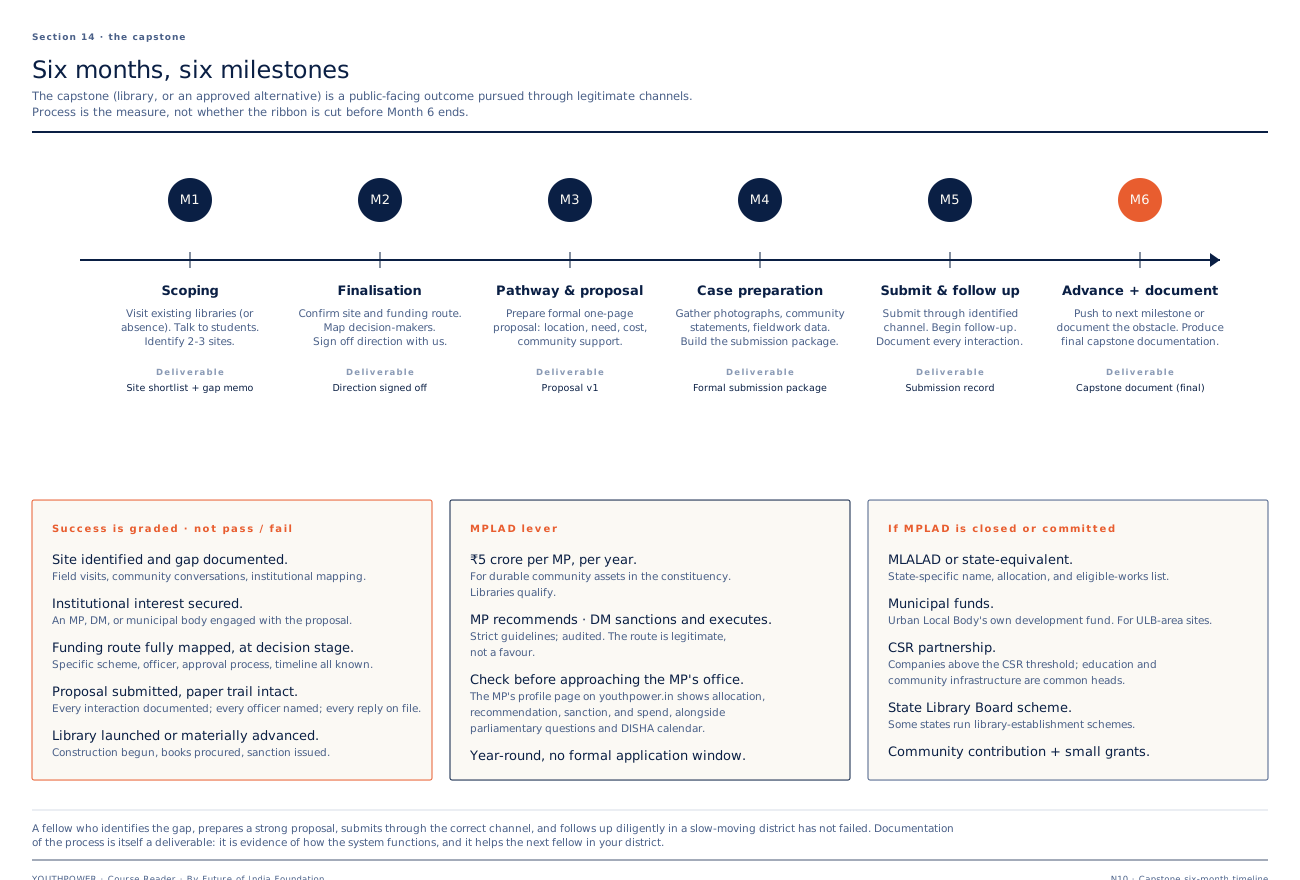
Not every fellow will see a library built in six months. The administrative cycle is often longer than that. What matters is the quality of the work at each stage, not whether the ribbon was cut before the fellowship ended.
These are the graded points of success, each one meaningful.
You identified a viable site and documented the library gap, through field visits, conversations with community members, and data from your institutional mapping.
You secured institutional interest. Someone in a position of authority engaged with your proposal. An MP's office agreed to consider it. A DM's office acknowledged the need. A municipal body expressed willingness to provide space.
You obtained written support or acknowledgment, a letter, a note in a meeting record, a formal expression of interest.
You mapped the full funding route. You know which scheme, which officer, which approval process, which timeline.
You moved the proposal to decision stage. It is before a decision-maker, with documentation, and awaiting action.
You launched or materially advanced the library. Construction began, books were procured, a space was designated, or a formal sanction was issued.
A fellow who identified the gap, prepared a strong proposal, submitted it through the correct channel, and followed up diligently in a district where administrative processes move slowly has not failed. The documentation of that process, what worked, what stalled, why, is itself a deliverable. It is evidence of how the system actually functions, and it will help the next fellow in that district.
A fellow who does serious, honest work in a difficult district has succeeded. A fellow who claims a library is "almost done" but cannot show the paper trail has not.
Direction set in Delhi, finalised by Month 2
Capstone framing happens during the Delhi orientation: you choose a direction with us based on your district. Through Months 1 and 2 you scope it on the ground. By the end of Month 2 the capstone is finalised and signed off. From Month 3 onwards you are executing.
Monthly milestones
Month 1: Scoping. Visit existing library infrastructure (or its absence) in your district. Talk to students, teachers, community members about where they study and read. Identify two or three potential sites. Document everything.
Month 2: Finalisation. Confirm the most viable site and the most viable funding route (MPLAD, MLALAD, municipal, CSR, state library systems, community contribution). Map the key decision-makers. Sign off the direction with us by end of Month 2.
Month 3: Pathway mapping and proposal. Prepare the formal one-page proposal: location, need, estimated cost, community support, sustainability plan. Submit it to us for feedback. Refine on feedback.
Month 4: Case preparation. Gather supporting evidence: photographs, community statements, data from your fieldwork. Prepare the formal submission package for the chosen channel.
Month 5: Submission and follow-up. Submit the proposal through the identified channel. Begin follow-up. Document every interaction: who you met, what was said, what the next step is.
Month 6: Advance or document the obstacle, and final documentation. If the proposal is progressing, push it toward the next milestone. If it is stalled, document precisely where and why (which office, which approval, what reason was given). Explore alternative routes if the primary one has closed. Regardless of where the proposal stands, produce a complete capstone document: the library gap, the route pursued, every step taken, every interaction documented, the current status, and a handover note for the next fellow or for FOIF to continue the work.
Alternative capstones
Not every district or every fellow will be best served by the library capstone. If you have identified a different district-level institutional improvement that meets the same criteria (public-facing, achievable through legitimate channels, meaningful for young people, documentable), you may propose an alternative capstone.
Submit the alternative proposal to us by end of Month 2. Include:
- What you propose to do.
- Why it is more appropriate than the library capstone for your district.
- Who the key actors are.
- What the funding or approval route is.
We will approve, suggest modifications, or redirect you to the library capstone. Alternative capstones follow the same monthly milestone structure and the same documentation requirements.
Examples of alternatives that have been approved in similar contexts:
- Establishing a structured apprenticeship-counselling programme at the Government ITI in coordination with the District Skill Development Officer and a few local employers.
- Reactivating a Government Polytechnic's career counselling cell so that final-year students receive structured placement support before they graduate, in coordination with the Polytechnic Principal and the District Skill Development Officer.
- Setting up a structured grievance interface between the District Welfare Office and a panchayat for scholarship applicants.
- Closing a specific Anganwadi supplementary-nutrition stock gap in one block, working with the Child Development Project Officer and the District Programme Officer.
- Working with the Common Service Centre operator on a specific service gap (Aadhaar update backlog, certificate processing time).
- Securing the sanction or revival of a Working Women's Hostel in the district, working with the District Social Welfare Officer and the relevant MP and MLA on the funding route.
- Working with the District Magistrate and the senior Lok Sabha MP to have the district's YouthPOWER report reviewed in one DISHA meeting each year.
From an illustrative direction to a workable proposal. Work backward from a single, observable outcome: what would exist or change in your district by Month 6 that does not exist today? Then name the single decision-maker whose approval would unlock that outcome — a Government Polytechnic principal, a CSC nodal officer, a District Skill Development Officer, a District Welfare Officer, a District Magistrate. Then map the funding or administrative route the decision-maker would invoke. If you cannot name the outcome, the decision-maker, and the route in three sentences, the proposal is not yet ready — keep scoping until it is.
These are illustrative. Your alternative will be specific to your district.