India's manufacturing workforce is mostly not in factories
Two in three of India's 5.25 crore manufacturing workers work outside factories, most in units of five people or fewer that produce a fraction of what factories do.
Topics: Jobs · Economy · Manufacturing
When we think of manufacturing, we think of factories and things being produced. What India counts as manufacturing includes those factories, and also the tailor stitching clothes to order, the bidi roller, the carpenter and the small flour mill. Most of them do not work in factories, and that says something about how India finds work for its people.
About one in five manufacturing workers is your friendly neighbourhood darzi (tailor)
In 2023-24, about 5.25 crore people worked in manufacturing across registered factories and small-scale unregistered units.¹ The single largest activity is custom tailoring. Nearly 99 lakh people stitch clothes to order, almost one in five of all manufacturing workers, and more than half as many people as all of India's factories employ together.² In small-scale units, bidi rolling employs about 20 lakh, wooden furniture about 12 lakh, flour milling about 10 lakh and brick making about 8.5 lakh.
Tailoring is also where much of the new work is. Between 2017-18 and 2025, manufacturing added workers and kept its share of all jobs at about 12%, and custom tailoring accounted for about one in five of the manufacturing workers added. Women's share of tailors rose from 44% to 71%.³
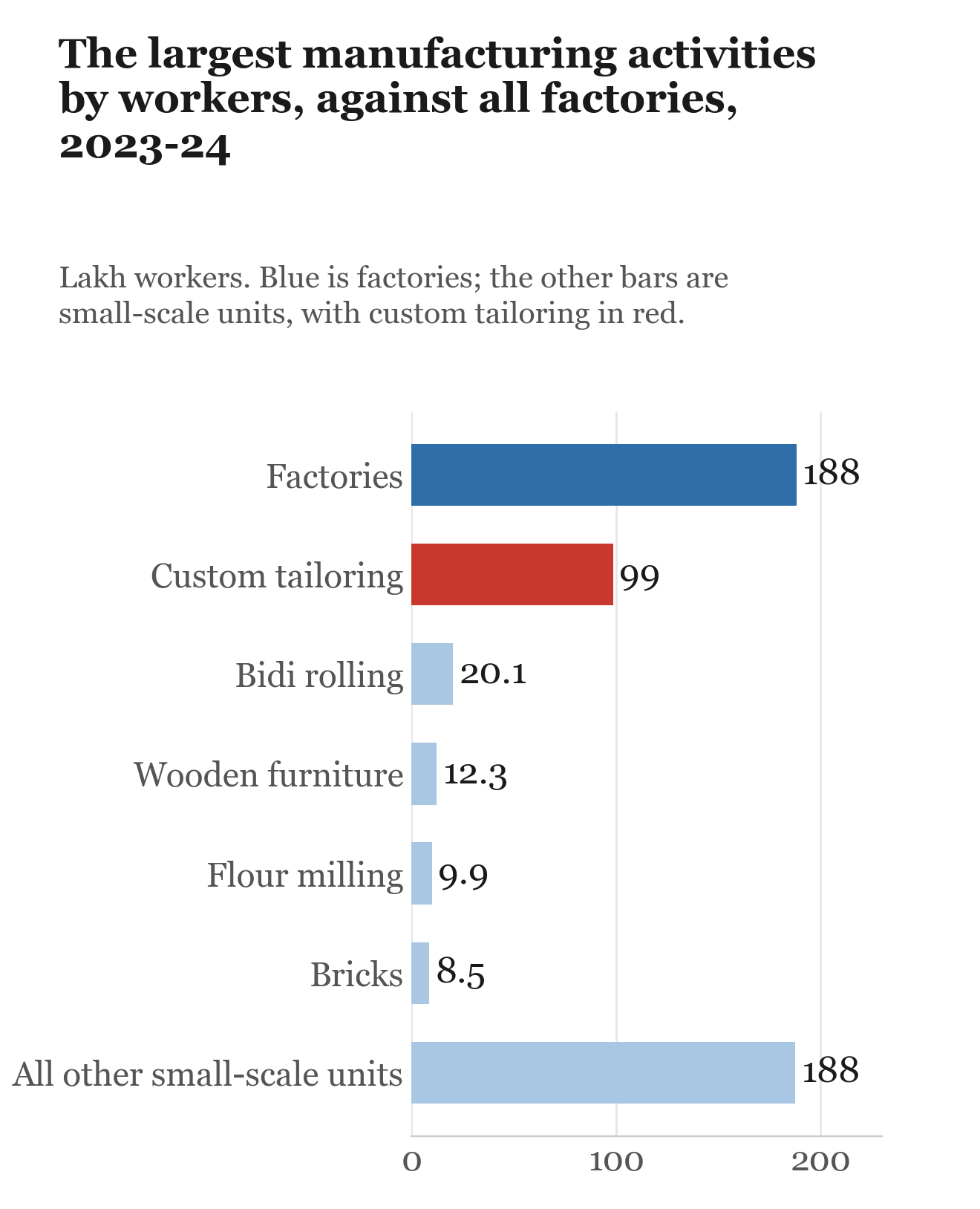 Source: Ministry of Statistics and Programme Implementation, 2023-24.
Two in three manufacturing workers are outside factories
Factories employed 1.88 crore people, about 36% of manufacturing workers. The other 3.37 crore, about 64%, worked in small-scale units.
India had about 1.84 lakh factories and about 2.01 crore small-scale manufacturing units, so factories are fewer than one in a hundred manufacturing units. Among the small-scale units, 72% have a single worker and 97% have five or fewer. At the other end, about 16,200 factories employ 250 or more people. They are 9% of factories and employ 59% of everyone who works in factories.
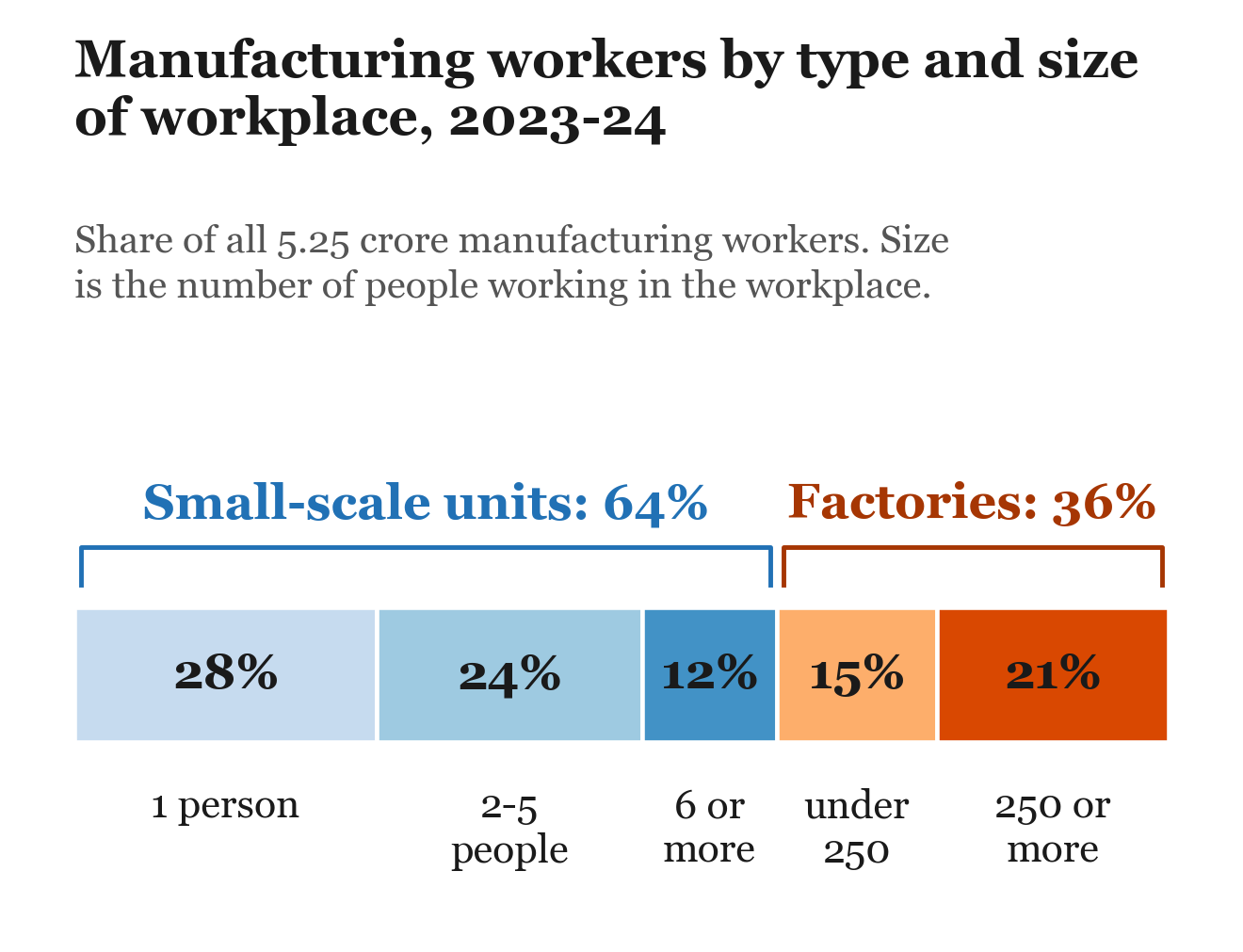 Source: Ministry of Statistics and Programme Implementation, 2023-24.
But factories produce most of the value
The 1.84 lakh factories produced about ₹23.2 lakh crore of value added, 86% of the total from both kinds of workplace.⁴ The small-scale units produced about ₹3.8 lakh crore. Value added per person was about ₹12.3 lakh in factories and ₹1.13 lakh in small-scale units, roughly eleven times as much.
Most small-scale manufacturing is self-employment, with short days and low earnings
Most people in small-scale manufacturing work for themselves. 88% of these units hire no one, and they hold 65% of the sector's workers. The typical one-person unit operates five hours a day, and a third operate four hours or less. The typical unit with ten or more workers operates ten hours.
A factory worker earned about ₹18,700 a month in 2023-24. A hired worker in a small-scale unit earned about ₹10,800, about three-fifths as much.⁵ In units that hire no one, the value each worker produced came to about ₹5,600 a month.⁶
Women are 47% of small-scale manufacturing workers and 74% of custom tailoring workers, and 85% of tailoring units are run from the owner's home. In factories, women are about one in ten workers.⁷
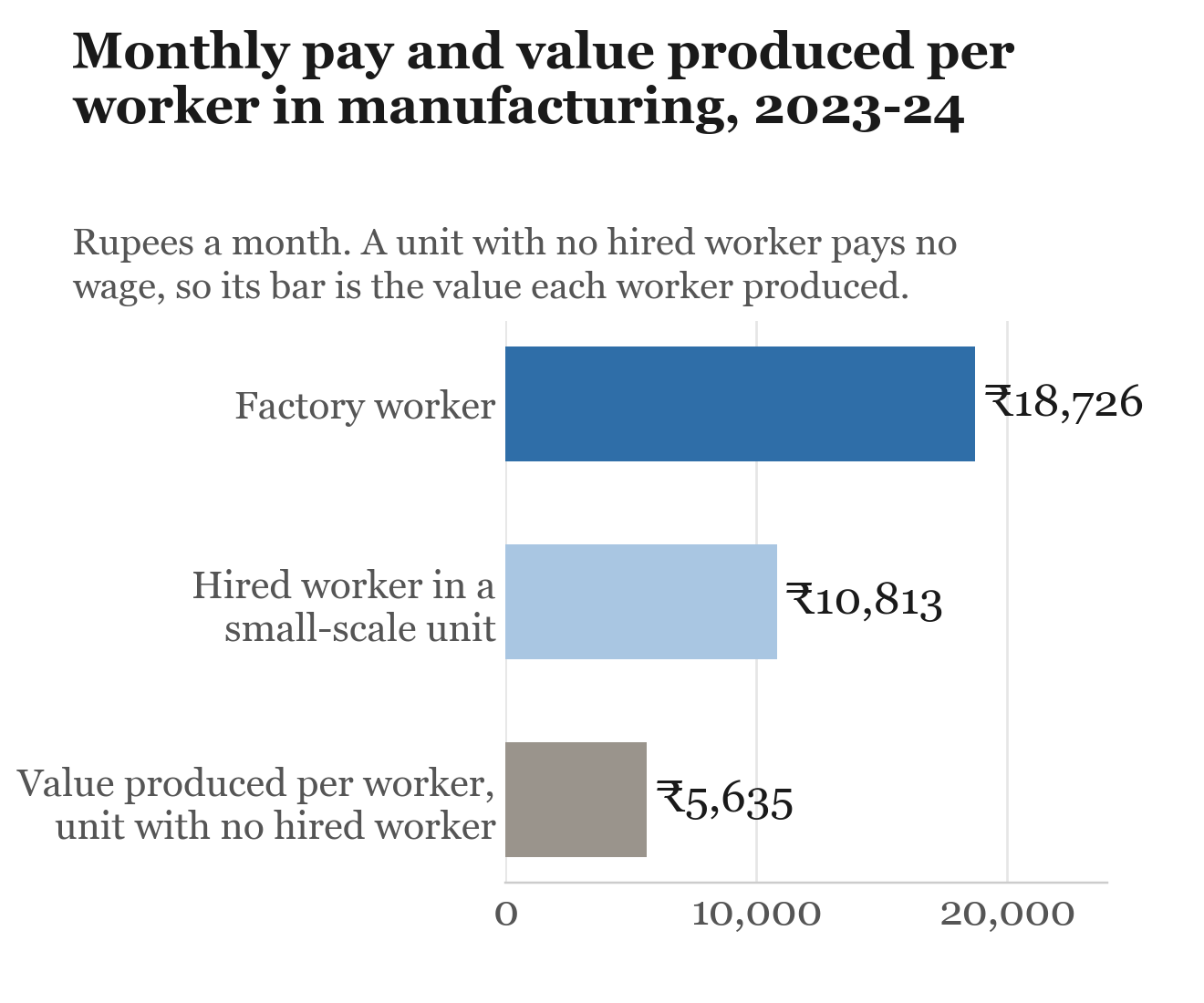 Source: Ministry of Statistics and Programme Implementation, 2023-24.
Like farming, small-scale manufacturing absorbs labour at low productivity
Agriculture holds 46% of India's workers and produces 19% of its value added.⁸ Inside manufacturing, small-scale units play the same part. They hold 64% of manufacturing workers and produce 14% of its value added. In both, work is split into small pieces, a plot of land or a one-person unit, with low output per worker. That fragmentation is how the economy finds work for people whom more productive firms do not employ.⁹
A following piece looks at how India's manufacturing has changed since liberalisation.
Notes
¹ Ministry of Statistics and Programme Implementation (MoSPI), 2023-24. Factories are open registered factories in manufacturing, counting everyone they employ (workers, supervisory and managerial staff, and unpaid family). Small-scale units are unincorporated manufacturing enterprises outside the factory register, counting owners, hired workers and unpaid family; a part-time worker counts as one. Following MoSPI's definition, small-scale manufacturing also includes cotton ginning; the factory figures cover manufacturing divisions only. Where one factory return covers several factories, its workers are divided equally among them to size each factory. A household survey of the same year counts 5.39 crore people aged 15 and above whose main work is manufacturing and 6.00 crore who do any manufacturing work, including as a side job; the 5.25 crore is 97% of the first and 88% of the second. The household survey counts people by the industry they work in and the business surveys count the people on each unit's rolls, so the totals are close but not interchangeable. Newer data are in note 9.
² Custom tailoring is stitching clothes to a customer's order. The industrial classification has placed it in manufacturing since the 1998 classification. In the 2011-12 national accounts series it was treated as a service.
³ MoSPI, 2017-18 and 2025, workers aged 15 and above, counting both main and side activity. The 2025 round uses a revised design and a calendar year, so comparisons with 2017-18 are indicative.
⁴ Value added is the value of output minus the cost of inputs, at current prices. The two surveys cover slightly different twelve-month periods.
⁵ Factory pay is wages and bonus per factory worker (production and contract workers, not supervisory or managerial staff); bonus is reported for each factory as a whole and is shared out in proportion to wages. Small-scale pay is wages, bonus and other benefits paid directly to each hired worker in units that hire. On both sides, employers' contributions to provident funds, insurance and shared facilities such as canteens are left out.
⁶ Value added per worker, before the owner pays any rent, interest or wear on equipment.
⁷ Share of all factory workers; contract workers are not recorded by sex, so this is a lower bound.
⁸ MoSPI, 2023-24: workers aged 15 and above, counting main and side activity; value added at current prices from the national accounts on the 2022-23 base.
⁹ The newest data point the same way: by 2025, 63% of manufacturing workers were outside factories, and three in four small-scale units had a single worker. MoSPI: small-scale units, January to December 2025; factories, 2024-25, from published tables by industry. The size of workplaces, the number of factories and women's share of factory workers need unit-level data, which has not yet been released for 2024-25. Those figures above are for 2023-24.
Follow our blog to stay updated on our programs and other content ↗