How is your district organised, and where do democracy, representation, and administration meet on the ground?
1
Read
3 sections of the Course Reader (~34 min)
2
Visit
3 anchor institutions
3
Write
District Democracy and Access Note
4
Quiz
5-question checkpoint
Read
The Republic and the district's place in it~12 min
~12 min read
2. The Republic and the district's place in it
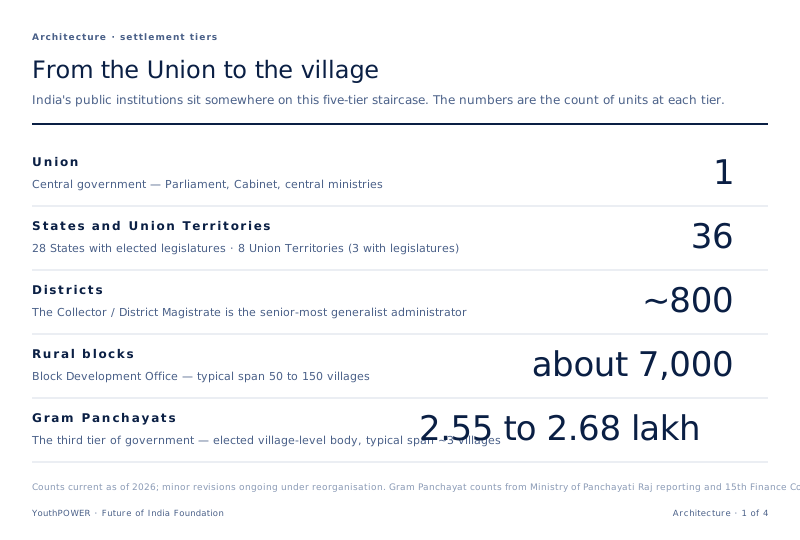
Architecture of the Republic — settlement tiers from Union to village
India is a union of states. The Constitution of India, adopted on 26 November 1949 and enforced on 26 January 1950, establishes a federal system with shared responsibilities between the Union Government in Delhi and the State Governments in each state capital. The Union legislates and funds certain subjects (defence, foreign affairs, currency, national highways, certain welfare schemes, the central armed forces and central police, and the central ministries of education, health, labour, agriculture, women and child development, skill development, rural development, and many others). The States legislate and deliver most of what touches daily life for ordinary people (schools, colleges, most hospitals, most skill-training institutions, police, land records, local administration). Some subjects are concurrent: both the Union and the State can act, and both do.
Below the State sits the district. Every State is divided into districts. There are around eight hundred districts across India today. The district is the administrative unit where the State Government meets the citizen. It is where the District Magistrate (sometimes called Deputy Commissioner or Collector, depending on the state) sits, where the line departments of the State have their district office, where the Lok Sabha Member of Parliament has constituency work, where the Members of the State Legislative Assembly represent their assembly constituencies, and where ordinary people go to receive government services.
Below the district, administration is organised at the block (rural) or the city or town (urban). Below the block, local self-government runs through the village panchayat. Below the city, local self-government runs through the municipal ward. The 73rd and 74th Amendments to the Constitution, passed in 1992, gave panchayats and municipalities constitutional status as the third tier of government, with their own elected representatives, their own functions, and their own financial allocations through state and central finance commissions.
This three-tier structure (Union, State, local) is not an organisational chart on a wall. It is how the Republic comes into contact with its citizens.
We derive our identity and sense of purpose in many ways: from country, from state, from family and social background, from the education we receive, from the views we form. India is far more than the sum of its public institutions. But our conception of the state is heavily influenced by how we encounter it.
A young person in Sitapur, in Jodhpur, in Darbhanga, may live her whole life inside her district. For her, the state is the school she attended, the ITI or college down the road, the Employment Exchange, the Tehsil office that issues her caste certificate, the bank where she applies for a Mudra loan, the Anganwadi her younger sibling goes to, the Primary Health Centre she visits when she is ill, the Common Service Centre where she gets her Aadhaar updated, the bus stand from which she travels to a nearby town for work. Whether the state works for her is almost entirely a question of whether these district institutions work.
That is why the YouthPOWER Fellowship is organised at the district.
The district as the meeting place
The district is unusual among Indian administrative units in that it is where three parallel systems of governance meet at the same place at the same time. Administration, representation, and adjudication run alongside each other at every level of the Republic. The columns are not single command chains, and every institution is affected by all three.
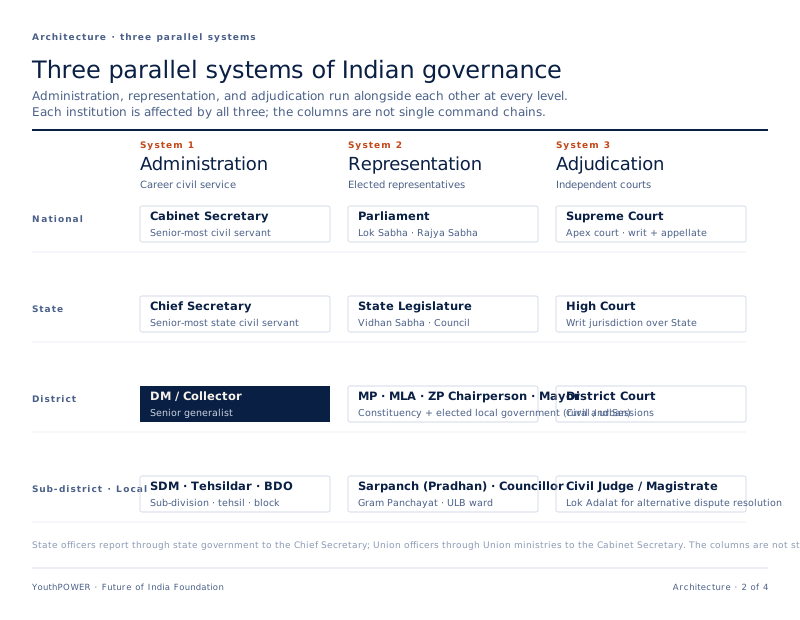
Three parallel systems of Indian governance — administration, representation, adjudication
The first system is administration. The District Magistrate sits at the apex of district administration. Under the DM are the Sub-Divisional Magistrates, the Tehsildars, and the Block Development Officers, all of them officers of the State Government. Each line department of the state (education, health, women and child development, social welfare, labour, industries, skill development, public works, agriculture) has its own district office: the District Education Officer, the Chief Medical Officer, the District Programme Officer for ICDS, the District Welfare Officer, the Labour Officer, the General Manager of the District Industries Centre, the District Skill Development Officer. These officers report up their own departmental hierarchy to the State directorate and ultimately to the State Secretary in the state capital.
The second is representation. The district is the constituency or part of the constituency of a Member of Parliament from the Lok Sabha. The district contains one or more Assembly constituencies, each represented by an MLA. The district's panchayats and municipalities have their own elected representatives: sarpanches, ward members, panchayat samiti members, zilla parishad members, councillors, mayors. The Rajya Sabha members from the state are not constituency-based but represent the state in the Council of States.
The third is adjudication. The district has a District Court. It has a District Legal Services Authority that delivers legal aid. It has police stations and courts under the criminal justice system. It has special courts for specific subjects (juvenile justice, family disputes, consumer disputes, motor accident claims).
What makes the district pedagogically interesting is that these three systems are independent. The DM does not direct the MP. The MP does not direct the courts. The courts do not direct the DM. They meet on the same physical territory, but their authorities are distinct. In most district decisions, two or three of these systems have a role to play, and the fellow's job is to learn to identify which system applies to which question.
The relationship between Union, State, and district
A young person in your district receives government services through several different routes simultaneously, and these routes have different funding origins.
Some services are funded entirely by the Union Government. The benefit may be delivered to the citizen directly through DBT or PFMS to an Aadhaar-linked bank account (PM-NAPS apprentice stipend share, NSP scholarships, PM-SVANidhi loans), or routed through state implementing agencies and frontline departments (PMAY-Gramin houses, VB-G RAM G wages, certain railway-related services, and the central armed forces).
Some services are funded entirely by the State Government and delivered by state line departments. Examples include the bulk of school education (state government schools, state pay scales for teachers, state textbooks, state board examinations), much of higher education (state universities, state degree colleges, state polytechnics), state-funded skilling programmes, state welfare schemes, state public works.
Some services are jointly funded under centrally sponsored schemes, with a 60-40, 75-25, or 90-10 sharing formula depending on the scheme and the state. Examples include Samagra Shiksha (school education), the National Health Mission (PHCs and CHCs), ICDS (Anganwadi), and many others. Funds flow from the Union ministry through a state society or directorate and then to district implementing units.
Some services are local-self-government driven, funded through state finance commissions and central finance commissions, with the Gram Panchayat or Urban Local Body as the decision-making unit. Examples include local sanitation, local roads, panchayat-level development works, and certain welfare schemes implemented at panchayat or ward level.
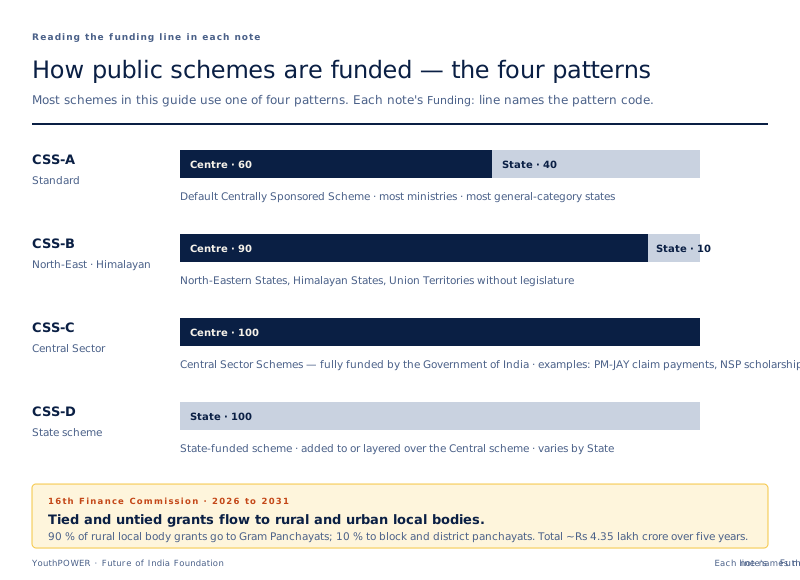
How public schemes are funded — the four patterns
A scheme journey typically crosses two or three of these funding routes. Tracing the journey of a single scheme from Union budget to a beneficiary in your district is, accordingly, one of the most useful exercises in this fellowship. Section 10 of this Reader walks through one such journey in detail.
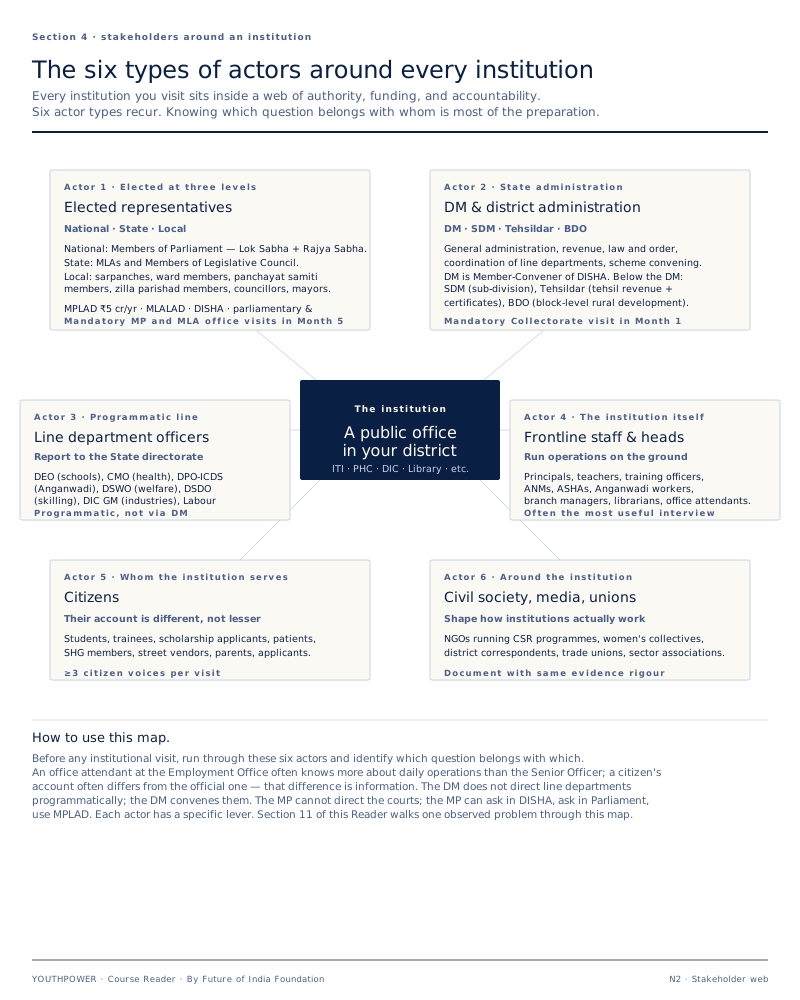
The stakeholder web around every public institution~10 min
~10 min read
4. The stakeholder web around every public institution
Every institution you visit during the fellowship exists in a web of authority, funding, and accountability. Understanding this web is one of the most useful pieces of preparation for the fellowship. It is what allows you to walk into a Government ITI on your first visit and know, within a few minutes of conversation, which questions to ask the Training Officer, which questions to save for the District Skill Development Officer, which questions belong with the State Director of Vocational Education, and which belong with the central Directorate General of Training in Delhi.
This section walks through the six types of stakeholder you will encounter at almost every institution.
The six types of actors around every institution
Elected representatives
Elected representatives operate at three levels of the Republic. National: Members of Parliament from the Lok Sabha (directly elected, each constituency around 1.5 to 2.5 million people) and Rajya Sabha (elected by State legislators). State: Members of the Legislative Assembly (directly elected, each constituency typically a few hundred thousand voters), and Members of the Legislative Council where the state has one. Local (the third tier under the 73rd and 74th Amendments): sarpanches and ward members at the Gram Panchayat, panchayat samiti members at the block, zilla parishad members at the district, and councillors and mayors in urban local bodies.
Each level has its own legislative subjects, its own constituent-redress role, and its own development-fund instruments. The fellow's mandatory MP and MLA office visits in Month 5 are with national and state representatives; local elected representatives appear at every panchayat and ULB visit.
MPLAD funds. Every MP receives Rs 5 crore per year under the Members of Parliament Local Area Development Scheme for recommending durable community assets in their constituency. The MP recommends the work; the District Collector's office sanctions and executes it. Eligible works include school buildings, library buildings, anganwadi buildings, drinking water facilities, certain road works, certain health facility upgrades, and many other public infrastructure items. MPLAD funds carry strict guidelines and are audited.
Parliamentary questions. MPs can ask the Union Government formal questions in either House on any subject. Starred questions are answered orally on the floor; unstarred questions are answered in writing and form part of the official record. Parliamentary questions are the most important formal mechanism through which the Union Government is held accountable for scheme implementation. A well-framed parliamentary question on, for example, why scholarships under NSP have not been disbursed in a specific district can produce a written answer that names the bottleneck.
DISHA. The District Development Coordination and Monitoring Committee, chaired by the senior Lok Sabha MP from the district, reviews implementation of central schemes at the district level. Members include other Lok Sabha MPs from the district, Rajya Sabha MPs from the state, MLAs from the district, the District Magistrate (Member-Convener), the Zilla Parishad Chairperson, the Mayor or Municipal Chairperson, and senior officers of major schemes. DISHA is the formal forum where central scheme implementation is discussed at district level. DISHA meetings are not open to the public.
MLALAD funds (or state equivalent). Most states have a Member of Legislative Assembly Local Area Development scheme equivalent to MPLAD, with state-specific names and budget sizes. Eligible works are similar to MPLAD: durable community assets, school buildings, anganwadi buildings, public works in the constituency.
Assembly questions. MLAs can ask the State Government formal questions on any state subject. State subjects govern most district institutions (school education, public health, agriculture, land, panchayati raj, urban development, labour welfare, social welfare, women and child development, industries, food and civil supplies, transport, police). Answers form the official record of the State Legislature.
Local government instruments. Gram Panchayats receive untied and tied grants from the Finance Commission and from state finance commissions; the elected sarpanch and ward members decide the use of those grants. Urban Local Bodies operate on similar lines. The Gram Sabha and the urban ward committee are the open public-decision forums of local government.
Constituency offices. Most MPs and MLAs maintain a constituency office in the district or major town within the constituency. The office handles constituent issues, meets visitors, processes scheme inquiries.
You can look up your MP's MPLAD usage, parliamentary questions, and DISHA calendar on the MP's page at youthpower.in. Do this before the orientation.
The District Magistrate and the district administration
The District Magistrate (or Deputy Commissioner, Collector, depending on the state) is the senior most officer of the State Government in the district. The DM is an officer of the Indian Administrative Service, the State Civil Service, or sometimes a direct-recruit promotee. The DM is responsible for general administration, revenue, law and order, coordination of line departments, and the implementation of state and central schemes that require district-level convening.
The DM is not the head of every department; line department officers (DEO, CMO, DPO-ICDS, etc.) report to their own state directorate, not to the DM, on programmatic matters. The DM does, however, convene them; chair district-level coordination meetings; review implementation; and escalate to the State Government on issues that require state-level attention.
The DM is also, by office, the Member-Convener of the DISHA committee. The DM works directly with the MP on DISHA-related coordination.
The DM's office in your district is the District Collectorate. The Collectorate is your first mandatory institutional visit in Month 1.
Below the DM are Sub-Divisional Magistrates (one per sub-division), Tehsildars (one per tehsil), and Block Development Officers (one per block). The SDM handles revenue, certain welfare schemes, certain coordination functions; the Tehsildar handles revenue records, certificates (caste, income, residence, birth, death), and revenue-related dispute resolution; the BDO handles rural development scheme implementation at block level.
Line department officers
Each line department of the State Government has a district office headed by a senior officer. These officers report to their state directorate.
Department
District officer
What they govern
School education
District Education Officer (DEO)
Government schools, KGBVs, school-level scheme implementation
Higher education
Principal of state universities, college Principals
Degree colleges, polytechnics
Health
Chief Medical Officer (CMO) / Civil Surgeon
District Hospital, CHCs, PHCs, sub-centres, health scheme implementation
Women and child development
District Programme Officer (ICDS)
Anganwadi network, ICDS supplementary nutrition, ECCE
Social welfare
District Social Welfare Officer (DSWO)
Welfare schemes for SC, ST, OBC, minority, disability, elderly
Labour
Labour Officer / Assistant Labour Commissioner
Labour welfare, workers' welfare boards, registration
Skill development
District Skill Development Officer (where present)
District-level coordination of PMKVY, ITI, JSS, RSETI, PMKK
Industries
General Manager, District Industries Centre (DIC GM)
Enterprise schemes, industrial promotion, MSME registration support
Agriculture
District Agriculture Officer
Agriculture extension, agri schemes, KVK linkage
Panchayati Raj / Rural Development
District Panchayat Raj Officer (DPRO) / Project Director DRDA
Rural schemes, VB-G RAM G implementation, RGSA capacity-building
Urban Development / Local Body
Municipal Commissioner / Executive Officer
Urban services, urban scheme implementation
Public works
Executive Engineer (PWD)
District infrastructure, public works
Food and Civil Supplies
District Supply Officer
PDS, ration shops, fair price shops
Police
Superintendent of Police (SP)
Law and order, criminal investigation
Revenue
Additional Collector / Sub-Divisional Magistrate
Revenue, land records, revenue-related disputes
You will encounter most of these officers, directly or indirectly, during the fellowship. Section 12 of this Reader, and the forty-two institution notes that follow Section 16, give the operational detail for each.
Frontline staff and institution heads
At every institution you visit, the actual operations are run by staff: principals, teachers, training officers, instructors, clerks, office attendants, ANMs, ASHAs, Anganwadi workers, ITI training officers, branch managers, lead bank managers, employment officers, scholarship clerks, librarians, transport staff. These are the people who run the institutions on the ground.
The frontline is also the most likely source of useful field information. An office attendant at the District Employment Office may know more about daily operations than the Senior Employment Officer. An Anganwadi worker may know more about the ground-truth of nutrition supplementation than the District Programme Officer. A Training Officer at a Government ITI may know more about why a trade is or is not running than anyone in the State Directorate of Vocational Education.
A core fellowship discipline is to be respectful to everyone, regardless of rank. Section 7 of this Reader, on engaging public officials and institutions, develops this in detail.
Citizens
Behind every institution are the citizens the institution exists to serve: students, trainees, scholarship applicants, patients, women's group members, street vendors, farmers, workers, parents, applicants. They have their own perspective on whether the institution is functioning. Their account often differs from the official account.
The fellowship requires you, at every institution visit, to speak to at least three citizens in addition to the staff. The student at the Government ITI, the trainee at PMKK, the patient at the PHC, the SHG member, the scholarship applicant, the parent at the Anganwadi. Their account is not less reliable than the official account; it is different, and the difference is information.
Civil society, media, parties, and unions
Around every institution sit other actors who are not part of the formal state but who shape how institutions work.
Civil society organisations (NGOs, foundations, community-based organisations, women's groups, youth groups) advocate, deliver, monitor, or contest. The CSR-funded NGO running the after-school programme at the secondary school. The private or NGO-run school nearby that competes with the government school. The women's collective that handles the SHG federation. The youth organisation that runs the library reading circle.
The local media (district-edition newspapers, local cable channels, district correspondents of state newspapers) cover or do not cover institutional issues. Some district reporters are excellent practitioners. Some are not.
Political parties have local cadre, local leaders, and local interests. The fellowship maintains strict neutrality on party politics; you will not engage with party offices or party representatives in any role except where they are also elected representatives.
Trade unions and informal-sector workers' associations advocate for their members. The construction workers' welfare board, the auto-rickshaw drivers' association, the street vendors' association.
These actors will appear in your fieldwork, sometimes prominently. Note when and how they intersect with the institutions you are documenting. Your formal documentation target remains the state, not these actors.
How policies travel, and why they fail~12 min
~12 min read
5. How policies travel, and why they fail
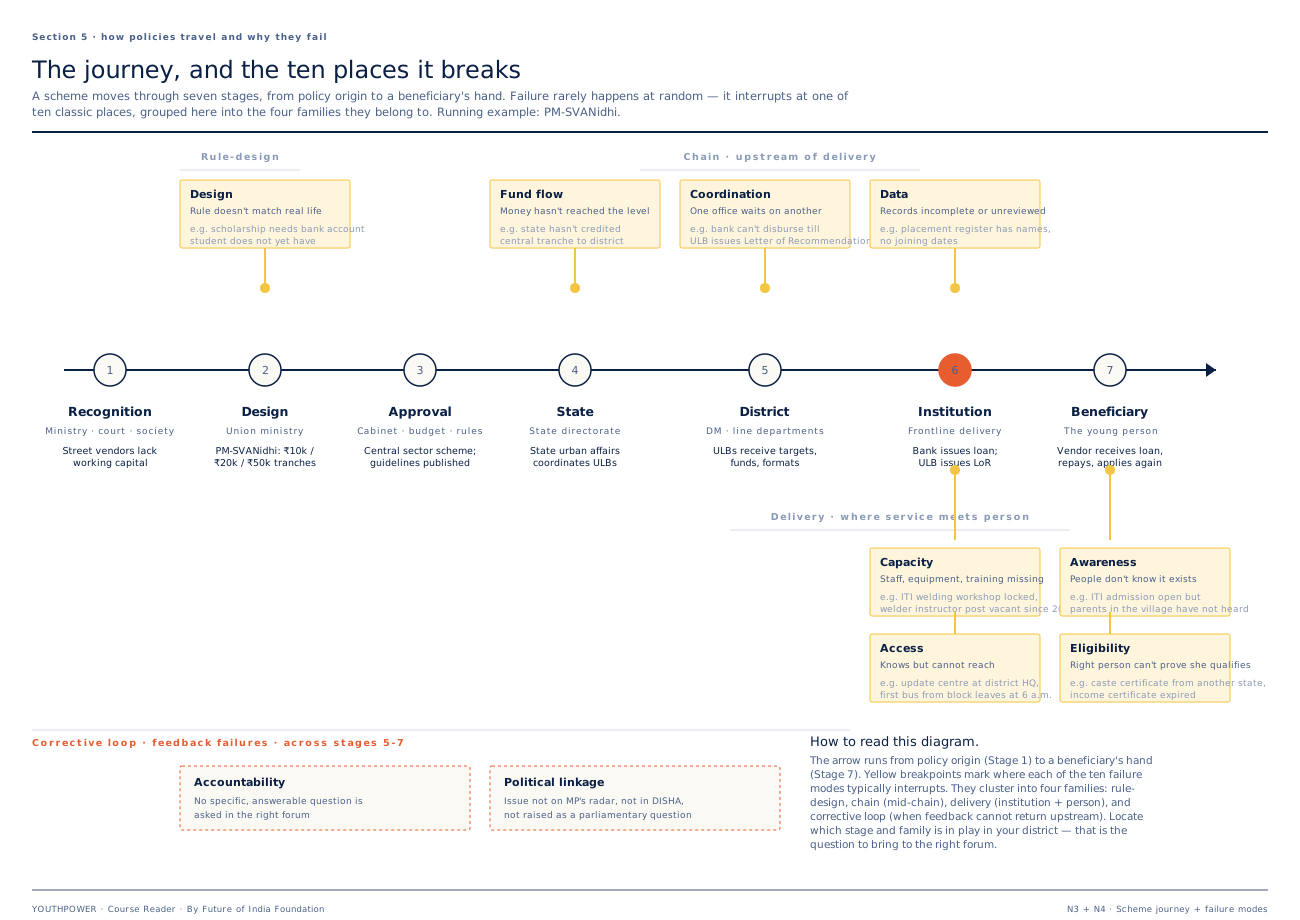
The seven-stage scheme journey, with ten breakpoints
Public policies in India do not begin and end in a single ministry. A scheme typically begins with a public problem, a political promise, a manifesto commitment, a court direction, a budget announcement, an administrative reform, an expert recommendation, or a demand from citizens or representatives. From there, the scheme travels.
The journey of a scheme
A typical centrally sponsored scheme travels through approximately seven stages.
Stage 1: Recognition of a public problem. A problem is identified by a Union ministry, a state government, a court, a parliamentary committee, an expert body, a civil society advocate, or an aggregation of citizen demand. For example, the recognition that street vendors lack working capital and lack access to formal credit.
Stage 2: Policy design. A Union ministry (or a state government for state schemes) designs a policy or scheme with a target group, an eligibility rule, a benefit structure, a delivery mechanism, an implementation chain, a budget, and a monitoring system. For street vendors, the design became the PM-SVANidhi scheme: collateral-free working capital loans in three tranches of ₹15,000, ₹25,000, and ₹50,000 (the scheme was restructured by Cabinet on 27 August 2025; lending period extended to 31 March 2030), delivered through commercial banks, urban cooperative banks, and small finance banks, with ULB-issued Letters of Recommendation. Vendors who repay the second tranche become eligible for a UPI-linked RuPay credit card.
Stage 3: Approval, budget, and rules. The scheme is approved by the Cabinet, with budget, sharing formula (centrally sponsored, central sector, or state-funded), guidelines, target numbers, and implementation timeline. The scheme guidelines are published and uploaded to the ministry's website and the relevant portal.
Stage 4: State-level adoption and adaptation. The scheme reaches the state level. The state government either implements it as designed (for centrally sponsored schemes with no state flexibility) or adapts it to state circumstances. State directorates issue their own circulars, rules, and procedural orders. State portals, state databases, and state implementation structures are activated. For a centrally sponsored scheme, the state society or directorate becomes the recipient of central funds and the disbursing authority for district-level implementation.
Stage 5: District-level reception. The scheme reaches the district. District line departments receive targets, funds (through the state society), reporting formats, and timelines. The DM or the relevant district officer designates a nodal officer for the scheme. District-level meetings are held to review progress.
Stage 6: Institution and frontline delivery. The scheme reaches the institutions and frontline staff that actually deliver it. For PM-SVANidhi, this means commercial bank branches issuing the loans, the ULB issuing the Letter of Recommendation, the street vendor applying.
Stage 7: Beneficiary experience. The street vendor applies, is verified, receives the loan, repays, and may apply for the next tranche. Or she does not, because some link in the chain has broken.
Where policies get stuck
Many policies get stuck in translation. The promise may be right, the design may be sound, the budget may exist, but the benefit still may not reach the young person. The fellowship trains you to locate where the process stops before suggesting a solution. There are ten classic stalling points. You will encounter most of them.
Design. The rule does not match the user's real life. A scholarship designed for college students requires a bank account and Aadhaar linkage that the student does not yet have. A skill-training scheme has eligibility cutoffs that exclude the most relevant candidates.
Eligibility. The right person cannot prove she qualifies in the form the scheme requires. Her caste certificate, issued some years ago, must now be revalidated before the scholarship application can be processed; the tahsildar's office takes six to eight weeks to do so, but the scholarship window is shorter. Or she is a legitimate Indian citizen but lacks the documents — tenth-class certificate, birth certificate, or a parent's name on an old voter roll — that the system now asks for as proof of identity and age. The beneficiary list is built on the 2011 SECC and has not been refreshed for households whose circumstances have changed since.
Awareness. People do not know the scheme or the service exists. Or they have heard of it but do not know how to access it. The ITI exists, but the parents in the village do not know about its admission process. The scholarship is open, but the school's notice board does not display it.
Access. People know about the scheme and qualify for it, but the entitlement does not reach them — either because of a rent or cut along the way, or because of a documentation cycle that keeps interrupting the flow. The clerk at the tahsildar's office moves the caste-certificate file only after an unofficial payment, which the scholarship applicant cannot afford. The fair-price-shop releases thirty-three kilograms of ration when the monthly entitlement is thirty-five. The bank account into which the DBT scholarship or pension lands is suspended on a re-KYC review and remains frozen for weeks while the depositor scrambles to produce fresh documents. The Aadhaar update centre's token system runs out before residents from far blocks can reach it; a one-day visit is not enough.
Capacity. The office does not have staff, equipment, time, or training. The Government ITI has no welder instructor; the post is vacant. The PHC has the medical officer but the lab technician is unfilled. The CSC operator has not been trained on the new scholarship portal.
Coordination. One office is waiting on another. The bank cannot disburse the PM-SVANidhi loan because the ULB has not issued the Letter of Recommendation. The college cannot release the scholarship because the state directorate has not credited the funds. The ITI cannot run the new trade because the equipment is being procured at the state level.
Fund flow. The money has not reached the right level at the right time. The state has not credited the central tranche. The district has not received the state allocation. The institution has not received the district allocation. The beneficiary has not received the institution-level disbursement.
Data. Records are incomplete, not current, or not actually reviewed. The placement register at the ITI lists 87 students as placed in 2024 but carries no data on whether those students joined the offered jobs or are still in them six months later. Beneficiary bank-account records carry transposed digits or name spellings that do not match Aadhaar, causing DBT disbursements to bounce repeatedly. The DLSA legal-aid record has applicant names but no entries on case outcomes or referral status.
Accountability. Nobody is asking a specific, answerable question in the right forum. The scheme exists, the gap is visible, but the gap has not been raised in DISHA, has not been asked as a parliamentary question, has not been taken up by the panchayat, has not reached the line department officer.
Political linkage. The issue has not reached an elected representative or public forum in a usable form. The MP's office may not even know that the scheme is failing in this particular block.
The fellowship's value, in part, is that disciplined district-level documentation can locate which of these failure modes applies to which specific gap. A vague complaint becomes a specific public question. A specific public question can be raised in the right forum by the right actor. That is how implementation improves.
The aim is not to blame quickly. The aim is to find where repair is possible.
Visit
3 anchor institutions for Module 1. Read the institution note for each, then go visit. Submit through Kobo to count toward Ambassador.
District Collectorate
Headed by the District Collector, who coordinates every central and state scheme, law and order, and revenue work.
Fifteen questions drawn from this module's three anchor institutions. The full District Quiz on your dashboard, with questions from all five pillars, is the one that earns the YouthPOWER Champion certificate.