~18 min read
10. A worked example: the journey of one scheme
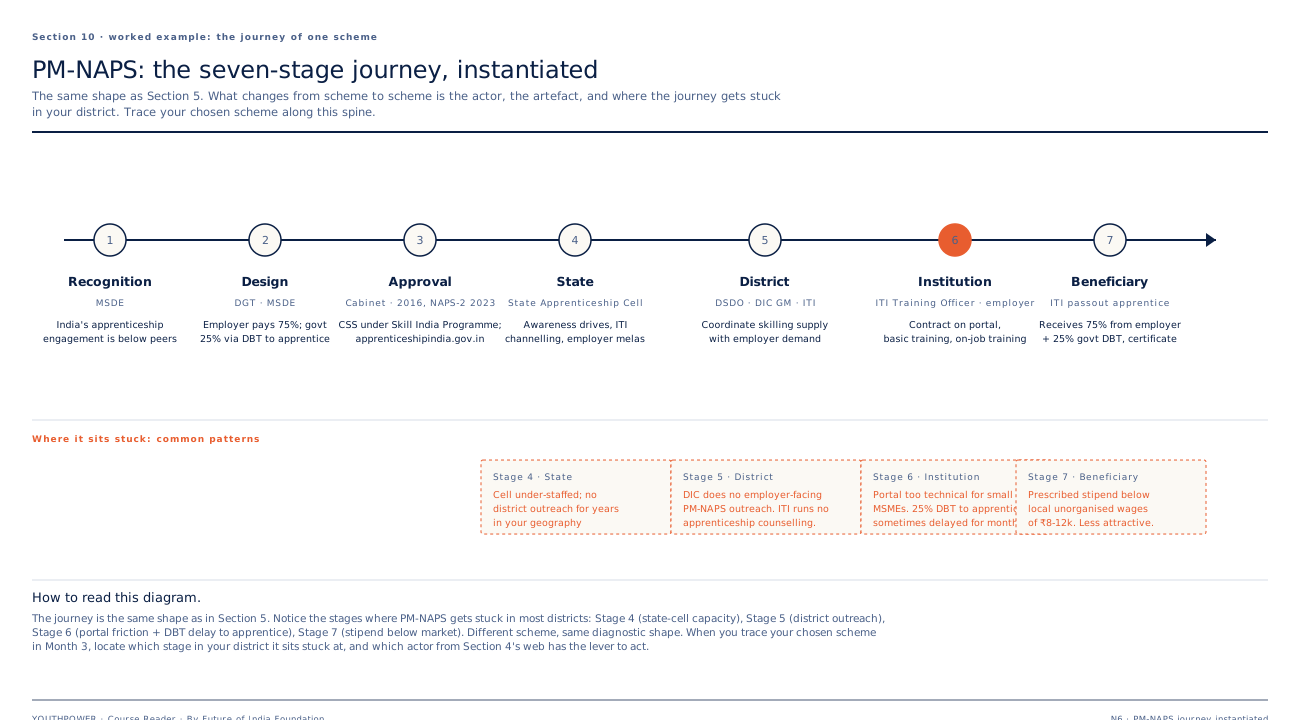
In Month 3 you submit a Scheme Journey Worksheet. The worksheet asks you to trace one scheme that runs in your district from policy origin to beneficiary experience. This section walks you through one such journey end to end, using the example of the National Apprenticeship Promotion Scheme. Read this example before you choose your scheme.
The scheme in question: PM-NAPS (formerly NAPS)
PM-NAPS (Pradhan Mantri National Apprenticeship Promotion Scheme, formerly NAPS) is a Central Sector Scheme of the Union Ministry of Skill Development and Entrepreneurship (MSDE). Since the Cabinet-approved restructure of 7 February 2025, PM-NAPS sits inside the composite Skill India Programme alongside Pradhan Mantri Kaushal Vikas Yojana (PMKVY) 4.0 and Jan Shikshan Sansthan (JSS). It promotes apprenticeship under the Apprentices Act, 1961 (most recently amended in 2014). Under the current NAPS-2 design, the employer pays 75% of the prescribed monthly stipend; the Government of India pays the remaining 25% (capped at ₹1,500 per month per apprentice) directly to the apprentice via Direct Benefit Transfer. PM-NAPS covers ITI-pass-out and other non-graduate apprentices; the parallel scheme for graduate and diploma apprentices is the National Apprenticeship Training Scheme (NATS), implemented by the Ministry of Education through nats.education.gov.in. The objective is to increase apprenticeship engagement by Indian employers and provide structured workplace training to young people aged 14 to 35 years.
The scheme is implemented through the Directorate General of Training (DGT) under MSDE. The portal is
apprenticeshipindia.gov.in. Establishments register on the portal, declare their apprenticeship slots, post training programmes, and receive matched apprentices. Apprentices register on the portal, identify themselves with Aadhaar, list their qualifications, and apply to programmes.Stage 1: The policy problem
India has historically had very low apprenticeship engagement compared to its peer economies (around 0.3% of the workforce in formal apprenticeship at scheme launch, against 3% to 8% for several European and East Asian economies). Indian employers under-invest in workplace training. Indian young people, especially ITI graduates, struggle to bridge the gap between training and employment. PM-NAPS (originally NAPS, launched 2016) was designed to crowd more apprenticeship engagement by sharing the cost of the apprentice's stipend; under the NAPS-2 restructure (2023), the government's 25% share is paid directly to the apprentice via Direct Benefit Transfer.
Stage 2: Scheme design
PM-NAPS, in its current form (NAPS-2, 2023 guidelines), has the following design.
- A registered employer (organisation, MSME, or any establishment with at least four employees) declares apprenticeship slots and training programmes on the portal.
- Apprentices register on the portal and apply to programmes.
- The employer signs an apprenticeship contract on the portal with the apprentice, with start date, duration, stipend, and training plan.
- The contract is uploaded; basic training (theoretical) is provided through a Basic Training Provider (BTP); on-the-job training is provided at the establishment.
- The employer pays 75% of the prescribed monthly stipend directly to the apprentice.
- The Government of India pays the remaining 25% (capped at ₹1,500 per month per apprentice) directly to the apprentice via Direct Benefit Transfer, after the establishment confirms its payment on the portal.
The scheme guidelines, the FAQ, and the latest circulars are available on the apprenticeshipindia.gov.in portal.
Stage 3: Approval, budget, rules
NAPS was launched in August 2016 and was restructured as NAPS-2 (PM-NAPS) under the MSDE 2023 operational guidelines, which are the operative form. It is approved by the Cabinet, with budget allocations and target apprentice numbers set annually by MSDE. The scheme is funded as a Central Sector Scheme. The Union government's 25% share is transferred to the apprentice via DBT; the state government does not contribute financially, but state directorates of training (DGT-state-counterpart) coordinate state-level outreach.
Stage 4: State adoption
Each state's Department of Training (or equivalent) coordinates apprenticeship engagement at state level. State Apprenticeship Cells run awareness drives, organise apprenticeship melas, work with state ITI directorates to channel ITI graduates into PM-NAPS apprenticeships, and engage with industry associations. The state engagement varies significantly: some states (Gujarat, Maharashtra, Tamil Nadu, Karnataka) have active state apprenticeship promotion cells; others have a thinner engagement.
Stage 5: District reception
At the district level, PM-NAPS reaches several touchpoints simultaneously.
The District Skill Development Officer (where present) coordinates skill-development activity including PM-NAPS awareness. The General Manager of the District Industries Centre maintains industry contact lists that overlap with apprenticeship-engaging employers. The Government ITI is the primary source of apprenticeship-eligible candidates and operates as a Basic Training Provider for many trades. The Model Career Centre or District Employment Exchange is a registration touchpoint for apprenticeship-seeking candidates and can match candidates to apprenticeship vacancies on the portal.
Stage 6: Institution and frontline delivery
At the level of the actual institution, PM-NAPS plays out in different ways.
At the Government ITI, the Training Officer maintains a list of employers who have engaged ITI passout students as apprentices. The TO sometimes runs apprenticeship-counselling sessions for final-year students. The TO can show you the placement register (which often includes apprenticeship placements alongside direct hiring).
At the District Industries Centre, the GM maintains industry contact lists and runs employer-facing awareness on PMEGP, MSME schemes, and (sometimes) PM-NAPS. The DIC may have done one or two apprenticeship awareness camps in the past year. Records, where they exist, are kept in a register at the GM's office.
At a private employer (MSME), the proprietor or HR coordinator handles apprenticeship engagement. The proprietor signs the contract on the portal, pays the stipend, and submits the claim for the 25% subsidy.
Optional extra credit. Ask the ITI principal which local MSMEs have recruited their pass-out students, and which have taken apprentices. Or ask the District Industries Centre for a list of MSMEs engaged on the apprenticeship portal. Visit one employer briefly. The proprietor's view of portal friction, the time taken for the subsidy disbursement, and the paperwork burden helps explain why apprenticeship engagement is high or low in the district.
Stage 7: Beneficiary experience
The young apprentice's experience runs roughly as follows.
She passes out from the Government ITI in her trade. She registers on the portal with her Aadhaar and qualifications. She applies to programmes. She receives an offer from a local manufacturing employer or, in some districts, from a national employer with operations in the area. She signs the apprenticeship contract on the portal. She begins her on-the-job training. She receives her stipend monthly (subject to the employer's compliance). She completes one or two years of apprenticeship. She may then be hired by the same employer, by a different employer, or she may move to other work.
Her experience varies. Some apprentices experience a smooth journey: registration, placement, regular stipend, job offer at the end. Some experience friction: unmatched portal listings, partial stipends, irregular payments, no job at the end. Some experience exploitation: stipends below the prescribed minimum, payment delays, unpaid overtime, lack of training, dismissal at the end without certification.
Where it can sit stuck
In your fellowship's district, PM-NAPS may sit stuck at one or more of the following points. These are illustrative scenarios drawn from how PM-NAPS implementation varies across districts, not assumed defaults. Verify which apply through your fieldwork.
The ITI does not run apprenticeship-counselling sessions. Final-year students do not know about PM-NAPS, do not register, and miss the route entirely.
The DIC does not do employer-facing PM-NAPS outreach. Local MSMEs that could engage apprentices do not know about the scheme, are unaware of the portal, and do not register.
The portal-led process is technical for many MSMEs. The proprietor of a small workshop may have heard of PM-NAPS but is reluctant to handle the registration, contract upload, claim filing, and TDS reconciliation himself. He hires apprentices outside the formal PM-NAPS route, on cash stipends, with no formal apprenticeship contract.
The 25% DBT to the apprentice is delayed. Disbursement of the government's 25% share to apprentices is sometimes delayed at one of the steps in the chain: contract approval on the portal, Aadhaar/bank/PFMS linkage of the apprentice, payment confirmation by the establishment, or state-level coordination through the RDSDE. Apprentices report not receiving the government share for several months.
The state's Apprenticeship Cell is under-staffed. No outreach drives in your district in the past year. The Cell exists in the State Directorate of Training but has no district presence.
Stipend levels are below market. In your district, many ITI-pass-out students can earn ₹8,000 to ₹12,000 in unorganised employment. The PM-NAPS-prescribed minimum stipend is often below this. Apprenticeship is, accordingly, not financially attractive even where it is available.
Which actor's mandate covers what
For each pattern of friction, a specific actor's mandate covers a specific lever.
MP. Can raise the disbursement-delay issue as a parliamentary question to the MSDE. Can raise the issue at DISHA. Can recommend MPLAD-funded durable apprenticeship infrastructure where guidelines permit, for example an ITI workshop building, a hostel for ITI students, lab equipment, or apprenticeship-cell space. (MPLAD funds durable public assets; it does not fund awareness drives or other soft activity.) Can write to the Director General of Training requesting a district-level review.
MLA. Can raise the ITI's apprenticeship-counselling absence with the State Directorate of Training. Can ask state-level questions on the State Apprenticeship Cell's outreach. Can recommend MLALAD-funded durable apprenticeship infrastructure where state MLALAD rules permit (typically ITI workshop equipment, hostel construction, or counselling-cell space). MLALAD does not fund awareness or promotional activity.
DM / Collectorate. Can convene a district-level apprenticeship review meeting with DIC, ITI, ULB, and a sample of employers. Can write to the State DGT counterpart requesting district-level outreach activity.
Line departments. District Skill Development Officer (where present) can run a district apprenticeship promotion drive with the DIC and the ITI. The DIC GM can include apprenticeship awareness in the next employer outreach. The ITI principal can institute an apprenticeship-counselling session for final-year students.
Citizens / NGOs / civil society. Can support outreach. Can document where the scheme is and is not reaching young people in the district. Can run student-orientation sessions at the ITI.
Your scheme journey worksheet
In your fellowship's Month 3, you will pick one scheme that runs in your district. PMEGP and PM-SVANidhi are good candidates if your district has visible enterprise activity. NSP (scholarships) and PM-NAPS are good candidates if your district has visible education and skilling activity. NRLM credit is a good candidate if your district has active SHGs. PMAY-Gramin is a good candidate if your district has visible housing activity. VB-G RAM G is a good candidate if your district is heavily rural.
For your chosen scheme, complete the Scheme Journey Worksheet in the Workbook (Volume 03) with the same structure as the example above:
- The scheme name and what it does.
- The policy problem it addresses.
- The scheme design (eligibility, benefit, delivery mechanism).
- The funding and administrative chain (Union, state, district).
- The institution(s) in your district that implement it.
- What records the institution should maintain.
- The beneficiary experience (interview at least two beneficiaries).
- Where the scheme sits stuck in your district, with evidence.
- The mandate map for one or two stages where the scheme gets stuck — for each stage and each relevant actor, the three questions: mandate, authority, engagement form.
- One question that, if asked in the right forum, could move the scheme forward in your district.
The worksheet is six to eight pages when completed seriously. It is the most analytically demanding submission of the first three months of the fellowship.