Open Fellowship › Module 5: Field Methods + Original Note + your MP
~6-8 hours · self-paced

Module 5 · Field Methods + Original Note + your MP

Can you now build governance knowledge yourself, and engage your MP respectfully and usefully?

1

Read

6 sections of the Course Reader (~72 min)

2

Visit

3 anchor institutions + 1 special visit

3

Write

Original Institution Note + Checklist

4

Quiz

5-question checkpoint

Read

Field Methods Module A: Interviewing for public-interest fieldwork~14 min
~14 min read

6. Field Methods Module A: Interviewing for public-interest fieldwork

Public-interest fieldwork is not activism, not journalism, not academic research, and not casual volunteering. It borrows from all four, but it is its own mode: structured, respectful, evidence-based, bounded, organisationally responsible. You are not trying to expose anyone. You are not writing a story. You are not proving a hypothesis. You are documenting how public institutions work for young people, accurately, across districts. The discipline required is different from what most of you have done before.
A good conversation is not a good interview. You can talk to a Training Officer at a Government ITI for forty minutes, cover many topics, laugh together, and walk away with nothing usable. A good field interview has purpose, structure, and discipline. It produces facts (names, numbers, dates, sequences) that can be verified and compared across districts.

Avoiding leading questions

A leading question tells the respondent what you expect to hear. "Don't you think the placement cell is ineffective?" is not a question, it is a suggestion. The respondent will often agree, because agreeing is easier than disagreeing with a stranger. Instead, ask: "How does the placement cell work here? When was the last campus placement drive? How many students were placed?" You are not looking for opinions about whether something works. You are looking for what actually happens.
This matters especially in institutional settings. If you ask a Block Education Officer, "Is teacher absenteeism a problem here?", you will get a defensive answer or a rehearsed one. If you ask, "How many teachers are posted at this school? How many were present when you last visited?", you get something you can work with.

Going deeper

The most important skill in field interviewing is the follow-up. First answers are almost always general. Your job is to move from general to specific. If a District Employment Officer says, "We run many skill programmes," your next question is not "That's great", it is "Which programmes are running right now? How many people enrolled last month? What trades are covered?" Every general claim should be followed by a request for an example, a date, a number, or a sequence of events.
The pattern is simple: general statement, then ask for specifics, then ask for one concrete example, then ask what happened next. A Zilla Parishad member says, "We have done a lot of work on education." You say: "Can you tell me about one specific thing that was done in the last year?" They mention a school renovation. You ask: "Which school? When was it completed? How much did it cost? Where did the funds come from?" Now you have something.

Listening for concrete detail

Notice when an answer contains no facts. "The situation is very bad" contains no facts. "There are supposed to be six teachers but only two are coming regularly" contains three facts. When you hear a vague answer, do not move on. Ask: "Can you give me an example?" or "When did this happen?" or "How many?"

Distinguishing direct knowledge from hearsay

People will tell you things they have heard from others as though they witnessed them personally. This is not dishonesty, it is how people talk. Your job is to sort it. When someone at a Jan Aushadhi Kendra says, "Medicines are always out of stock," ask: "Have you come here before and found medicines unavailable? When was that? Which medicine were you looking for?" The difference between "I came three times last month and they didn't have paracetamol" and "everyone says there's nothing here" is the difference between evidence and rumour.

Handling sensitive topics

You will encounter situations where people want to talk about specific individuals: a corrupt official, a negligent teacher, a hostile clerk. Your job is to redirect toward systems, not persons. Instead of collecting allegations about a named individual, ask about the process: "What happens when someone files a complaint here? Is there a register? How long does it typically take?" You are documenting how institutions function, not building cases against individuals.

Separating observation from interpretation

While interviewing, you will constantly be tempted to interpret what you see. A half-empty classroom might mean poor attendance, or it might mean a field trip, or it might mean the afternoon shift hasn't started. Note what you observe. Ask about it. Do not leap to conclusions during the interview itself, that will shape your subsequent questions and close off information you have not yet received.

Ending the interview

Always end with: "Is there anything important I did not ask you about?" This is not a formality. Some of the most important information in the fellowship will come from this question, because it lets the respondent raise what matters to them, not just what you thought to ask.

Ethics

Do not record audio without informing the person. Do not photograph children's faces unnecessarily. Do not fabricate or embellish. Record what you see and what you are told, and be clear about which is which. If you are unsure about something, write that you are unsure. An honest gap is always better than a confident fabrication.

Bad interview vs good interview: a worked example

The setting is a Government ITI. The fellow is speaking with the Training Officer.

Bad interview

Fellow: "So the ITI isn't really working properly, right?"
Training Officer: "Well, there are some challenges..."
Fellow: "I heard placement rates are very low. Is that true?"
Training Officer: "It depends on the trade."
Fellow: "But most students don't get jobs after completing, right?"
Training Officer: "Some do, some don't."
Fellow: "And the equipment is probably outdated?"
Training Officer: "We have some new equipment also."
Fellow: "Okay. So basically the main problem is lack of government attention?"
Training Officer: "Yes, you could say that."
This interview lasted fifteen minutes and produced nothing. Every question told the respondent what to say. The fellow walked away believing the ITI is failing, but has no facts. No numbers, no dates, no specifics. The Training Officer gave the path-of-least-resistance answer to every leading question.

Good interview

Fellow: "How many trades does this ITI offer?"
Training Officer: "Eight trades. Fitter, electrician, welder, Electronic Mechanic, mechanic diesel, turner, stenography Hindi, and dress-making."
Fellow: "How many students are enrolled this year across all trades?"
Training Officer: "Around 420. Sanctioned intake is 512."
Fellow: "Which trades are full and which have vacancies?"
Training Officer: "Electrician and Electronic Mechanic are full. Dress-making has only 8 students against 32 seats."
Fellow: "Why is dress-making so low?"
Training Officer: "Students in this area prefer Electronic Mechanic now. There is steady local demand for repair and assembly work. Dress-making feels outdated to them."
Fellow: "What about placements? How many students from last year's batch got jobs?"
Training Officer: "From the 2024 batch, 87 students were placed through campus drives. Total passed out was around 380."
Fellow: "Which trades had the best placement?"
Training Officer: "Electrician, almost all of them. Fitter also. Electronic Mechanic placement is harder because there are so many Electronic Mechanic graduates from private ITIs too."
Fellow: "How many instructors do you have against sanctioned posts?"
Training Officer: "Sanctioned is 14. We have 9. Three posts have been vacant for over two years. The welder instructor retired in 2023 and that post is still empty."
Fellow: "How is welding taught without a welding instructor?"
Training Officer: "The fitter instructor covers some theory. Practicals are limited."
Fellow: "When was the last time new equipment was received?"
Training Officer: "We got CNC machines in 2021 under the World Bank scheme. Before that, most equipment is from 2008-09."
Fellow: "Is there anything important I haven't asked about?"
Training Officer: "You should know that we have no hostel. Students from far blocks can't attend. That affects enrollment more than anything."
This interview took twelve minutes and produced: enrollment numbers, vacancy patterns by trade, placement data, instructor vacancies with timelines, equipment age, a specific gap (no welder instructor for two years), and an infrastructure fact (no hostel) that the fellow would not have known to ask about.
Functional outcome for this module. You should be able to conduct a 10-20 minute semi-structured interview, capture key facts and quotations accurately, and produce a short summary that distinguishes reported experience from your own interpretation.
Field Methods Module B: Engaging public officials and institutions~12 min
~12 min read

7. Field Methods Module B: Engaging public officials and institutions

Every week, you will walk into institutions where nobody is expecting you and nobody owes you anything. How you present yourself in the first sixty seconds will determine whether you get access, cooperation, and useful information, or whether you are politely shown the door.

The introduction

Memorise this and use it every time:
"My name is [name]. I am a fellow with the Future of India Foundation. We are documenting how public institutions work for young people at the district level. This is a letter from the Foundation."
Hand over the letter as you say the last sentence. Let the official read it. If they want to keep a photocopy, let them. The letter establishes who you are and what you are doing. It does not establish authority, and you must never treat it as though it does.

What you must never say

These are hard rules, not guidelines.
Never claim government authority. You are not from the government. You are not affiliated with any ministry. If asked, say clearly: "We are a non-profit organisation. We are not connected to any government body."
Never imply endorsement. If a District Collector received your team politely last month, that does not mean the DM has endorsed the fellowship. Do not tell the next official, "The DM knows about us" as though it implies permission or backing.
Never promise anything on behalf of FOIF. Do not say "We will help get this fixed" or "We will bring this to the government's attention." You are documenting. You are not an intermediary, an ombudsman, or an advocate.
Never threaten. Not even mildly. Not "I will have to report this" or "This will be in our findings." You have no enforcement power and must never pretend otherwise.
Keep politics out of institutional conversations. People can and should have personal political preferences, including yours. Bringing those preferences into an institutional conversation, to attribute motives to officials or to score points across party lines, is unnecessary and counterproductive. Stick to facts. Be neutral. If an official raises politics, listen but steer the conversation back to the institutional matter at hand.

How to request information

Be specific. "Can you tell me about this institution?" is too vague and puts the burden on the official. "How many beneficiaries were registered under PM-SVANidhi in this district last year?" is specific and answerable. Officials respond better to precise questions because precise questions signal that you have done your preparation and are not wasting their time.

Reading the room

Reading the room is a skill, not a checklist. You will speak with very different people across the same week, sometimes the same morning, and learning to read each room and adjust your approach is part of the fellowship's training. Below are five reception styles you will commonly encounter; the more institutions you visit, the more naturally you will recognise them and respond.
The busy officer has ten files on the desk and three people waiting. Be brief. Ask your three most important questions. Offer to come back. Do not linger.
The dismissive officer does not take you seriously. Stay polite. Ask one or two factual questions. If they engage, continue. If they do not, thank them and leave. Note the visit.
The quietly open officer will not volunteer much but will answer what you ask. These are often the most productive interviews. Ask specific questions. Follow up. Do not fill silences, let them think.
The enthusiastic officer wants to show you everything and talk for an hour. This is valuable but requires discipline on your part. Let them talk, but keep steering toward facts, numbers, and specifics. Do not let enthusiasm substitute for evidence.
The suspicious officer thinks you might be from the media, an RTI activist, or a political operative. This is understandable, they have encountered all three. Restate who you are. Show the letter. Be transparent. If they remain uncomfortable, do not push. Thank them and leave.

Speaking to different people

You will speak with clerks, office attendants, principals, senior officers, elected representatives, and citizens, sometimes in the same building on the same day. Three principles run through every conversation.
Be respectful without being deferential. Do not change your fundamental posture based on rank. An office attendant at the District Employment Office may know more about daily operations than the officer in charge. A ward member may know more about a school's actual condition than the BEO. Speak to each person as a fellow adult doing a job.
Be specific. Generic questions get generic answers. Specific questions show you have done your homework and are not wasting the official's time. Read the institution's note from your coursepack, check the relevant portal, and arrive with two or three precise questions ready.
Know who can answer what. Operational detail belongs with the frontline (Training Officer, ANM, Anganwadi worker, branch manager). Programmatic and budget questions belong with senior officers (CMO, DEO, DIC GM). Policy interpretation and rule-making belong with line directorates at the state and central level. Asking an office attendant about a state directorate decision, or a senior officer about which exact register a clerk maintains, signals that you have not prepared. Match the question to the role.

Access versus endorsement

This distinction is critical. When an official receives you politely, answers your questions, and shows you around, that is access. It is not endorsement. It does not mean they agree with your work, support FOIF, or want to be associated with your findings. Never represent a cooperative visit as institutional backing. Never say, "The principal was very supportive of our work" in your notes. Say, "The principal provided access and answered questions."

Handling "come later" and "send it on WhatsApp"

You will hear both frequently. "Come later" sometimes means the person is genuinely busy and sometimes means they hope you will not return. In either case, ask: "When would be a good time? I can come back tomorrow at 11." Pin down a time. If they remain vague, thank them, leave, and try again another day. "Send it on WhatsApp" is sometimes a brush-off and sometimes a genuine preference. If someone prefers written questions on WhatsApp, accommodate them, but follow up if you do not hear back within three days.

When you are denied access

It will happen. An official may refuse to speak with you. A guard may not let you enter. A clerk may insist you need permission from someone who is never available. When this happens, leave politely and note the visit.
A denied first visit is part of fieldwork. How you handle it is also how public officials begin to take you seriously over time. A polite return on another day, with a more specific question and a clearer sense of what you want to ask, often turns a closed door into an open one. Engaging public officials respectfully and persistently, until they recognise you as someone doing serious work, is itself a skill the fellowship is helping you build.

Conduct

Dress appropriately. Not formally, but neatly. Arrive on time or slightly early. Carry your identification letter and a notebook. Silence your phone.
Functional outcome for this module. You should be able to approach any public institution (a Government ITI, a District Employment Office, a Block Education Office, a Jan Aushadhi Kendra, a public library, an MP's constituency office) confidently, politely, and safely, without creating confusion, conflict, or reputational risk for yourself or for FOIF.

Field Methods Module C: Writing field notes and evidence summaries~14 min
~14 min read

8. Field Methods Module C: Writing field notes and evidence summaries

Without field notes, fieldwork does not exist. You may visit thirty institutions in a month, but if you do not write them up, you have nothing. Not for yourself, not for the programme, not for the fellows who come after you. Field notes and your KoboToolbox checklist submissions are the two primary written outputs of this fellowship. Everything else (trackers, the capstone, the final reflection) builds on them.

The three-way separation

Every field note distinguishes between what you observed directly, what you were told, and what you infer from the combination. "The Anganwadi was closed at 11 AM on a working day" is observation. "A neighbour said the worker has been on long leave" is testimony. "The Anganwadi appears to be functioning irregularly" is inference. All three may belong in your note; the discipline is to keep them clearly separated. Section 9 of this Reader names the underlying four orders of evidence; the tag system below is the operational form.

Evidence tags

Use these consistently across every field note:
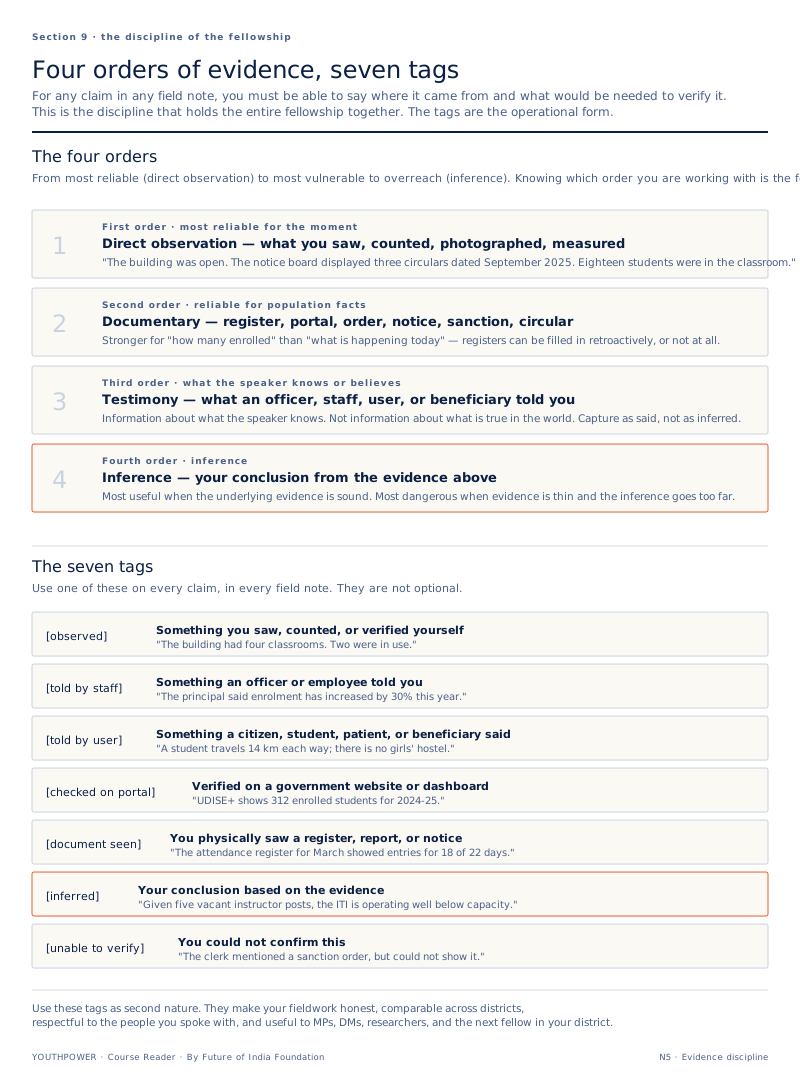
[observed] — something you saw, counted, or verified with your own eyes. "The building had four classrooms. Two were in use. [observed]"
[told by staff] — something an official or employee told you. "The principal said enrollment has increased by 30% this year. [told by staff]"
[told by user] — something a citizen, student, patient, or beneficiary told you. "A student said she travels 14 kilometres each way because there is no girls' hostel. [told by user]"
[checked on portal] — something you verified on a government website or dashboard. "The UDISE+ portal shows 312 enrolled students for 2024-25. [checked on portal]"
[document seen] — you physically saw a register, report, or notice. "The attendance register for March showed entries for 18 of 22 working days. [document seen]"
[inferred] — your conclusion based on evidence. "Given the five vacant instructor posts and the 2008-era equipment, the ITI appears to be operating well below capacity. [inferred]"
[unable to verify] — you could not confirm this. "The clerk mentioned that a new building has been sanctioned, but could not show the order. [unable to verify]"
Use these tags in every field note. They are not optional.

Field note structure

Every note should follow this sequence.
Header. Institution name, location, date, time of visit, who you met (by designation, not necessarily by name).
Lead sentence. The finding, not the visit. Not "I visited the Government ITI on Tuesday." Instead: "The Government ITI in Banda has five of fourteen instructor posts vacant, including the welding instructor, who retired in 2023 and has not been replaced."
What you observed. Physical condition, what was open and operating, how many people were present, what was visibly functional or non-functional.
What you were told. Key statements from officials, staff, or users, with evidence tags.
Documents accessed. Notice boards, signboards, scheme posters, reception information, displayed contact lists, portal pages — what is publicly visible. And, where voluntarily shared by staff, registers, records, or internal dashboards. What you saw, and what it showed.
What was not accessible. Doors that were locked, records that were not available, people who were absent.
Contradictions. Where what you saw did not match what you were told, or where different people gave different accounts.
Inference. Your assessment, clearly labelled as inference, based on everything above.

Writing useful first sentences

The lead sentence is the most important sentence in your field note. It must contain a finding. Compare:
Weak. "I visited the District Employment Office in Gonda on 14 March 2027."
Strong. "The District Employment Office in Gonda has conducted two job fairs in the past twelve months, against a target of four, and has no record of post-fair placement tracking. [told by staff, document seen]"
The first sentence tells me you went somewhere. The second tells me what you found. Always lead with the finding.

Writing when the visit was inconclusive

Not every visit produces a clear finding. Sometimes the officer was absent. Sometimes you got limited access. Sometimes the information was contradictory and you could not resolve it. Write it up anyway. An honest account of an inconclusive visit is valuable. It tells the next person what to expect, and it prevents the same dead end from being repeated.
"The Block Education Office was open but the BEO was on tour. The clerk was unable to answer questions about teacher vacancies and directed me to return next week. The notice board displayed circulars from 2023. [observed]"
This is a valid field note. It is short, honest, and useful.

Recording contradictions

You will frequently encounter situations where the official account and the observable reality do not match. Record both without overstating the contradiction.
"The principal said the attendance rate is 80%. The register for February showed students marked present on 12 of 20 working days, suggesting a rate closer to 60%. The discrepancy may reflect different definitions of attendance or different time periods. [told by staff, document seen, inferred]"
This is honest and measured. It is not your job to declare someone a liar. It is your job to note what you were told and what you saw, and to flag when they diverge.

Connecting one visit to the larger picture

Each visit is one data point. Your field notes should, where possible, note how this visit connects to broader patterns in your district.
Most fellows will visit each institution type only once, so cross-institution inferences are the exception, not the rule. But if you were doing a longer follow-on study of local ITIs — say, the Government ITI and two Private ITIs in different blocks — you could write:
"Instructors were present in sanctioned posts at all three ITIs, but workshop-side teaching was not actually happening: welding workshops locked at all three; machines bore tarpaulins last lifted two years ago; students reported practicals had not been run this semester. The pattern suggests sanctioned strength on the muster roll without functional workshop teaching. [inferred from multiple visits]"
This kind of linking observation is what makes field notes more than bureaucratic checklists.

Preserving uncertainty honestly

If you are not sure, say so.
"The equipment appeared old but I could not determine its year of manufacture. [observed, unable to verify]"
is better than guessing a date.
"It is unclear whether the low enrollment is due to lack of demand or lack of awareness about the programme. [inferred]"
is better than picking one explanation and asserting it.

Writing clearly

Use short sentences. Use plain words. Avoid jargon unless it is the institution's own terminology (in which case, explain it the first time). Do not exaggerate. When you encounter an institution that is partly working and partly not, describe what you saw precisely — "operating below stated capacity" or "running three of seven trades" — rather than collapsing the picture into "completely non-functional." Reserve "non-functional" for institutions that are actually closed or that have stopped delivering their core mandate.

Model field note

Government Industrial Training Institute, Banda, Uttar Pradesh
Date: 18 March 2027 | Time: 10:30 AM - 11:45 AM Met: Training Officer (TO), one instructor (Fitter trade)
The Government ITI in Banda operates eight trades with 420 enrolled students against a sanctioned intake of 512, with five of fourteen instructor posts vacant including three that have been unfilled for over two years. [told by staff]
The campus has four workshop blocks and one classroom block. The electrician and Electronic Mechanic workshops were in active use at the time of the visit, with students present and equipment running. [observed] The welding workshop was locked. The TO said the welding instructor retired in 2023 and the post has not been filled; the fitter instructor covers some welding theory. [told by staff] I could not verify practical welding training. [unable to verify]
The TO reported that 87 of approximately 380 students from the 2024 batch were placed through campus recruitment drives, a rate of roughly 23%. Electrician had the highest placement; Electronic Mechanic placement was described as "harder" because of competition from private ITI graduates. [told by staff] The notice board at the entrance displayed a list of empanelled employers and the current admission process for 2027 intake. [observed] The TO voluntarily showed me the placement register, where entries were consistent with these numbers, though some entries were partially filled — employer name present but joining date blank. [document seen]
The dress-making trade has 8 students against 32 sanctioned seats. The TO attributed this to a shift in student trade preferences in recent years. [told by staff]
CNC machines received under a World Bank-funded scheme in 2021 were installed and appeared operational. Other equipment (lathes, milling machines) bore inventory tags dated 2008-09. [observed] The TO said no new general equipment has been received since 2009 apart from the CNC machines. [told by staff]
The institution has no hostel. The TO stated that this affects enrollment from distant blocks more than any other single factor. [told by staff] Several students I spoke with briefly confirmed long commute times, with one reporting a daily round trip of three hours. [told by user]
Overall, the ITI appears to be functioning but significantly constrained by instructor vacancies, outdated non-CNC equipment, and the absence of a hostel. The combination means that at least two trades (welding, dress-making) are effectively non-viable in their current form. [inferred]

Model visit summary

Banda Government ITI, 18 March 2027. Eight trades running, 420 of 512 seats filled. Five of fourteen instructor posts vacant, including welding (vacant since 2023, no replacement, workshop locked). Placement rate approximately 23% for 2024 batch, strongest in electrician. CNC machines from 2021 functional; other equipment dates to 2008-09. Dress-making has 8 of 32 seats filled. No hostel, which the Training Officer identified as the primary barrier to enrollment from distant blocks. Workshop activity below stated capacity across multiple trades.
Functional outcome for this module. You should be able to produce a clear 300-500 word field note with evidence tags, a concise visit summary, and an evidence-based observation that links one visit to a larger question about how institutions are working in your district.

Evidence and documentation: the discipline of the fellowship~10 min
~10 min read

9. Evidence and documentation: the discipline of the fellowship

The three field-method modules in Sections 6, 7, and 8 give you the practical skills. This section names the underlying discipline that holds them together. The fellowship's distinctive contribution to public-interest fieldwork in India, as we understand it, is the discipline of evidence: of always being able to say, for any claim in your notes, where the claim came from and what would be needed to verify it.
The discipline of evidence — four orders and seven tags

The four orders of evidence

In the field, you will encounter four orders of evidence. They are not equally reliable. Knowing which order you are working with is the foundation of honest documentation.
First order: direct observation. Something you saw, counted, photographed, measured, or otherwise verified with your own senses. The building was open. The notice board displayed three circulars dated September 2025. The classroom had eighteen students seated. The water tap ran. The toilet door was locked. The training officer was at her desk.
This is the most reliable order, but it has limits. You can observe what is visible at the time of your visit, not what is happening on average. You can observe a single moment, not a pattern.
Second order: documentary evidence. What the institution has put in the public domain — a notice board, a signboard, a scheme poster, reception information, a displayed contact list, a displayed grievance procedure, the relevant portal page. And, where staff voluntarily show you, a register, an order, a circular, or a sanction letter. You read the notice board. You photographed the signboard. You read the portal. The clerk offered to show the register; you noted what it contained.
Publicly-displayed documentary evidence carries the institution's own stated version of what it does, and is reliable in that limited sense. Registers and internal records, where voluntarily shared, can be more reliable for facts about a population (how many students enrolled) than direct observation (which students are present today); they are less reliable for what is happening in practice, because registers can be filled in retroactively, or filled in incorrectly, or not filled in at all. Pressing for register inspection is not the fellowship's posture: note what is displayed, photograph what is offered, and move on.
Third order: testimony. Something an officer, staff member, user, beneficiary, or citizen told you. The principal said. The training officer said. The student said. The Anganwadi worker said. The woman at the bank said.
Testimony is information about what the speaker knows or believes. It is not information about what is true in the world. The same staff member, in good faith, may report things she has heard from others as though she witnessed them. The same beneficiary, in good faith, may report a single bad experience as a permanent state.
Fourth order: inference. Your conclusion, drawn from the combination of observation, documents, and testimony. Given that the building was open, the notice board carried fresh circulars, and the principal showed the register, the school appears to be functional. Given that the welder instructor's post has been vacant since 2023 and the workshop was locked, practical welding training is likely not happening.
Inference is your contribution to the documentation. It is the most useful when the underlying evidence is sound. It is dangerous when the underlying evidence is thin and the inference goes too far.

What the tags do for you

The seven tags introduced in Section 8 are the operational form of these four orders. They do four things. First, they make your fieldwork honest — you cannot smuggle a guess into a field note as though it were a fact, because the tag forces you to declare. Second, they make your fieldwork comparable across districts: the same tag-system produces submissions that can be sorted, filtered, and analysed without losing the underlying provenance. Third, they make your fieldwork respectful to the people you spoke with — the respondent's account is captured as testimony, not laundered into your inference. Fourth, they make your fieldwork useful to others. An MP's office, a DM's office, a researcher, a future fellow, can read your note and understand exactly what you saw, what you were told, and what you concluded.

Common evidence-discipline failures, and how to avoid them

Single-visit overreach. A fellow visits a school once on a Friday afternoon, finds it half empty, and concludes attendance is poor. The school may have had a half-day for an event. A single visit cannot establish a pattern. Either visit again, or document the single visit and flag the limitation. Acceptable: "On Friday afternoon, attendance was approximately 40% [observed]. This may not be representative; a return visit on a regular morning would help establish the typical pattern. [unable to verify]"
Confused testimony as fact. A fellow writes, "Teacher absenteeism is high at this school." She does not say where she got this. Was it the principal's testimony? The students'? The block clerk's? The fellow's own observation across visits? Each of these has different reliability. The discipline forces precision: "The principal said attendance rates of teachers are roughly 70%. [told by staff] On the day of the visit, three of seven teachers were present. [observed] No register of teacher attendance was made available. [unable to verify]"
Inference disguised as observation. "The CSC operator was overcharging." Did you see him take money? Did the user tell you he was charging more than the official rate? Did you check the official rate yourself? Each of these would be a different claim. The discipline: "The official Aadhaar demographic-update fee is ₹75 [checked on portal]. Two users I spoke with said they were charged ₹150 [told by user]. The CSC operator denied this when asked [told by staff]. [contradiction noted]"
The seductive inference. Sometimes the inference is so obviously correct that you skip the evidence. The hospital is dirty, the staff are rude, the doctor is absent, "this PHC is non-functional". Slow down. Each of those is an inference. What did you observe? What did you measure? "The PHC was open. The CMO was absent on the day of visit; the BMO was reportedly on a meeting at the district headquarters. [told by staff] No medical officer was at the institution at the time of visit (10:30 AM). [observed] The OPD had four patients waiting. The labour room appeared clean. The Anganwadi-PHC linkage register was visible at the desk. [observed] Signboard listed seven medical officers; current strength is two, per the staff list at the wall. [observed] [document seen]"
The discipline is not pedantic. It is what makes your work usable beyond yourself.

The standard your work will be held to

Your work will be considered acceptable if it meets the following minimum quality standard, which is also the standard we use when reviewing your field notes.
The submission identifies the institution clearly: name, location, date, time, persons met by designation. The submission distinguishes observation, testimony, document evidence, portal data, and inference using the tag system. The submission includes enough specificity for another person to understand what was found. The submission avoids unsupported claims. The submission is written in neutral, professional language.
A submission that meets this standard is accepted. A submission that does not is returned with feedback for revision. We are reading for these criteria, not for elegance or length.

Designing your own institution note~12 min
~12 min read

12. Designing your own institution note

In Month 5 you write one institutional note from scratch. This is the assignment that converts you from observer to practitioner. The note follows the same structure as the forty-two notes that appear after Section 16 of this Reader, but you choose the institution.
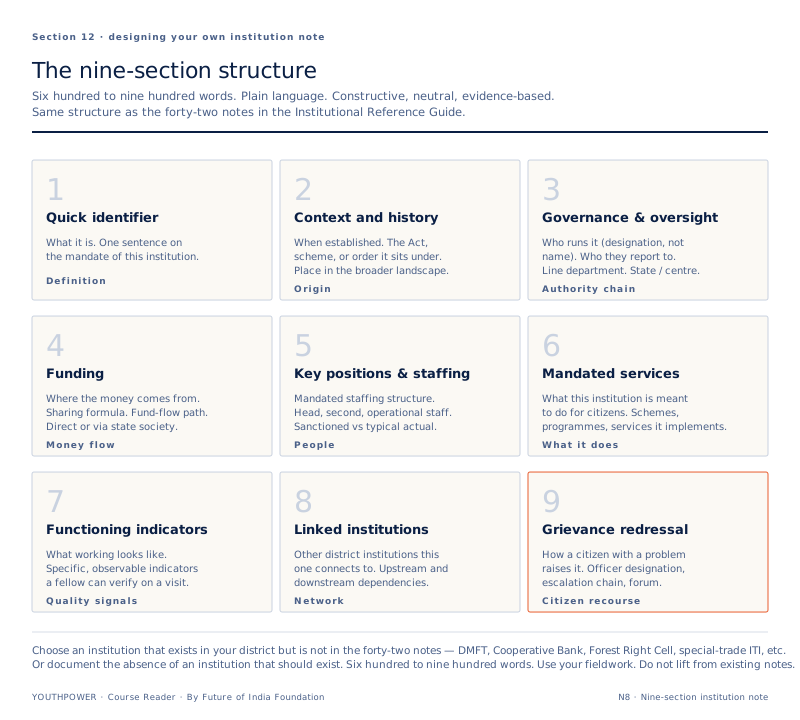
The nine sections of an institution note

What to choose

You may choose:
An institution not in the forty-two but present in your district. For example, the Khadi and Village Industries Commission Field Office, the District Mineral Foundation Trust, the Forest Right Implementation Cell, the District Disability Rehabilitation Centre, the District Tourism Office, the Cooperative Bank, the District Marketing Federation, the District Sericulture Office, the Backward Region Grant Fund Cell.
A sub-institution or a local variant of one of the forty-two. For example, the State Government's special-trade ITI in your district that runs trades not covered by the central note (mineral processing in mining districts, marine engineering in coastal districts, jewellery design in cluster districts).
An institution that should exist in your district but does not. This is a "document the absence" note. The institution's mandate is described, the absence in your district is documented, and the consequences are noted.

Length and style

Six hundred to nine hundred words. Same nine-section format as the forty-two notes. Plain language. Same tone (constructive, neutral, evidence-based).

The nine sections

1. Institution name and quick identifier

What it is. One sentence on the mandate.

2. Context and history

How and when this institution was established. The Act, scheme, or order under which it was created. Its place in the broader institutional landscape (which pillar, which parent department, which state or central scheme).

3. Governance and oversight

Who runs it (designation, not name). Who they report to. Which line department it sits under. Which scheme or rule it is governed by. State/central role.

4. Funding

Where the funding comes from. The scheme allocation, sharing formula, fund flow path. Whether the institution receives funds directly or through a state society / district society / line department.

5. Key positions and staffing

The mandated staffing structure. Who is the head; who is second; who are the operational staff. Sanctioned strength versus typical actual strength.

6. Mandated services

What this institution is supposed to do for citizens, beneficiaries, students, or whoever its users are. The list of services, programmes, or schemes the institution implements or supports.

7. Functioning indicators

What "functioning" looks like. Specific, observable indicators. (For example, for a Sericulture Office: number of cocoon banks operating, number of farmer training programmes per quarter, number of registered sericulture farmers, last farmer-grievance-handling note.)

8. Linked institutions

What other district institutions this one connects to. (For example, a Sericulture Office connects to KVK, the agriculture department, banks for farmer credit, FPOs.)

9. Grievance redressal

How a citizen who has a problem with this institution can raise it. The complaint registration process, the grievance officer (designation), the escalation chain.

A model note (illustrative)

The following short note illustrates the format and tone. It is for an institution not in the forty-two: the District Mineral Foundation Trust (DMFT).

District Mineral Foundation Trust
Quick identifier. A trust established under the Mines and Minerals (Development and Regulation) Act, 2015 to fund welfare and infrastructure works in mining-affected areas of mining districts. Funded through statutory contributions from mining lease holders.
Context and history. The DMFT mechanism was created by Section 9B inserted by the 2015 Amendment to the MMDR Act, 1957. The Pradhan Mantri Khanij Kshetra Kalyan Yojana operates through DMFTs. The DMFT is established at district level in every district where mining activities take place. Funds are statutorily contributed by lease holders, for major minerals, at 10% of royalty for leases granted on or after 12 January 2015 (post-amendment, typically auctioned leases) and 30% of royalty for leases granted before that date. Minor minerals follow state-specific rules. State governments operationalise DMFTs through state DMFT rules.
Governance and oversight. Headed by the District Magistrate as Chairperson. Governing Council includes representatives of local elected representatives, state line departments, and mining-affected community representatives. The Trust functions under state DMFT rules and is monitored by the Ministry of Mines through periodic reporting and the PMKKKY portal.
Funding. Through statutory contributions by mining lease holders. The corpus accumulates over time. Under the PMKKKY revised guidelines of 15 January 2024 (which state DMF rules are required to incorporate), at least 70% of the corpus must be spent on high-priority sectors (drinking water, environment and pollution control, healthcare, education, welfare of women and children, welfare of the aged and differently abled, skill development and livelihood generation, sanitation, housing); up to 30% on other priority areas (physical infrastructure, irrigation, energy and watershed development, environmental quality). At least 70% of funds must be directed to areas directly affected by mining.
Key positions and staffing. Chairperson: District Magistrate. Member-Convener: typically the Additional Collector (Mining) or the District Mining Officer. Member-Secretary: typically a senior officer of the state mines department posted at district level. Operational support: project monitoring unit, data entry support, finance officer.
Mandated services. (a) Identification of mining-affected villages and citizens. (b) Approval of welfare and infrastructure projects funded from the DMFT corpus. (c) Implementation through state line departments or specially-empanelled implementing agencies. (d) Monitoring and reporting on the PMKKKY portal. (e) Beneficiary verification and grievance handling.
Functioning indicators. (a) Annual receipt of statutory contributions, against the lease portfolio in the district. (b) Sanctioned projects, sanctioned amount, and disbursed amount in the current and previous year. (c) Number of mining-affected villages identified. (d) Number of beneficiaries reached, by category. (e) PMKKKY portal entry status.
Linked institutions. District Magistrate's office (chair, oversight), District Mining Office (operational), State Mines Department (rule-making, monitoring), Line departments (implementing agencies for sanctioned projects), Panchayats and ULBs of mining-affected areas (beneficiary identification), Mining lease holders (contributors).
Grievance redressal. Complaints regarding DMFT-funded projects may be filed at the District Magistrate's office or through the PMKKKY portal. Beneficiary identification grievances are handled through the village-level identification process. Allegations of fund misuse may be raised through state government grievance mechanisms or through the Ministry of Mines portal.

The note is short, factual, and structured. Your assignment in Month 5 is to write one such note for an institution of your choice in your district, using your fieldwork as the basis.

Common pitfalls in the original-note assignment

Failing to disaggregate mandate. Many district institutions carry several distinct mandates at once. The Block Development Office covers VB-G RAM G implementation, panchayat support, rural housing schemes, and line-department coordination. The District Industries Centre covers PMEGP, single-window clearance, MSME registration, and industrial estate management. The skill the note is teaching is to recognise these as separate mandates and write about them as such, rather than mixing them in the same sentence. A note that says "the BDO handles rural development and convenes line-department meetings and supports panchayats" reads as activity-coverage; a note that takes each mandate, names the legal source, the funding line, the staff, and the working unit, reads as institutional analysis. You may write about the institution as a whole, or about one mandate within it; either way, name which mandate every sentence is in.
Generic content. Your note should be specific to your district. The DMFT note above is generic; in your district, the note would carry the actual head's designation, the actual lease portfolio, the actual number of mining-affected villages, the actual portal entries. Use your fieldwork.
Confused with capstone. The original institution note is not the capstone proposal. It is a description of the institution, not a request for the institution to do something. Keep them distinct.
Lifting from existing notes. Do not copy from the forty-two notes (which are drawn from the Institutional Reference Guide). The point of the assignment is the practice of writing from your own observation.

Designing your own checklist~10 min
~10 min read

13. Designing your own checklist

The companion assignment in Month 5 is to design a fifteen to twenty question checklist for the same institution as your original note. This is the checklist a future fellow could use to visit the institution.
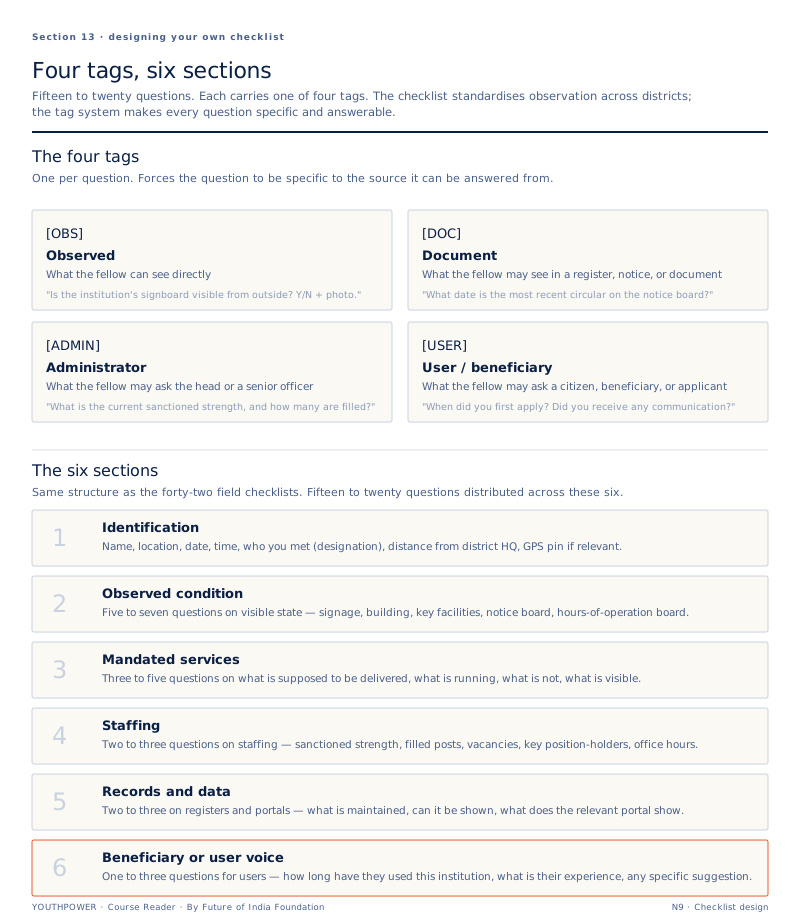
Checklist design — four tags and six sections

What a checklist does

A checklist standardises observation. It ensures that across districts, the same type of institution is documented along the same dimensions. It also forces specific, answerable questions: not "is this institution functioning" (a yes/no opinion), but "is the notice board displayed; is it dated within the last six months; what does it list" (a Y/N + photo + what-do-you-see triad that someone else can verify).

The four-tag system

Every question in your checklist carries one of four tags:
[OBS] — what the fellow can observe directly. Example: "Is the institution's signboard visible from outside? Y/N + photo."
[DOC] — what the fellow may see in a publicly displayed document: a notice board entry, a signboard, a scheme poster, a displayed circular, a displayed contact list, the relevant portal page. And, where staff voluntarily share them, a register or internal record. Example: "What is the date of the most recent circular displayed on the notice board? [DOC]"
[ADMIN] — what the fellow may ask the head of the institution or a senior officer. Example: "What is the current sanctioned strength of staff, and how many are filled? [ADMIN]"
[USER] — what the fellow may ask a user, beneficiary, or citizen. Example: "When did you first apply for this scheme? Did you receive any communication after applying? [USER]"

Structure of the checklist

The checklist follows the Course Reader's six-section structure (the same structure as the forty-two checklists in your coursepack).
Section 1: Identification. Institution name, location, date, time of visit, who you met (designation), distance from district headquarters, GPS / location pin if relevant.
Section 2: Observed condition. Five to seven questions on the visible state of the institution: signage, building condition, key facility availability (hand pump, toilets, electricity, internet), notice board content, displayed circulars, displayed grievance contact, hours-of-operation board.
Section 3: Mandated services. Three to five questions on the services the institution is supposed to deliver: which schemes are listed; which are running; which are not; what services are visible.
Section 4: Staffing. Two to three questions on staffing: sanctioned strength, filled posts, vacancies, key position-holders, office hours.
Section 5: Records and data — public and offered. Two to three questions on what the institution has chosen to display about its records and data: what is on the notice board, what scheme-poster or fact-sheet is posted at reception, what is on the relevant portal. If a register or internal record is voluntarily shown by staff, note what it contains. Do not press for register inspection — the fellowship's posture is to document what is displayed and what is offered, not to audit the institution's internal files.
Section 6: Beneficiary or user voice. One to three questions for users / beneficiaries: how long have they used this institution, what is their experience, do they have any specific suggestion.

A worked example

Suppose the fellow is designing a checklist for the District Mineral Foundation Trust office (the institution she described in her original note). The checklist might look like the following.

Section 1: Identification

  1. Office name, address, GPS coordinates, date and time of visit. [OBS]
  2. Officer met (designation). [OBS]

Section 2: Observed condition

  1. Is the DMFT office signboard visible? Y/N + photo. [OBS]
  2. What is on the notice board? Photo + brief listing. [OBS]
  3. Is the FY annual report or the PMKKKY portal status displayed? Y/N + photo. [OBS]
  4. Is a list of mining-affected villages identified by the DMFT displayed? Y/N + photo. [OBS]
  5. Is a grievance officer designation and contact displayed? Y/N + photo. [OBS]

Section 3: Mandated services

  1. What is the corpus accumulated under the DMFT in the current and previous financial year? [ADMIN]
  2. How many projects have been sanctioned in the current FY, and how many disbursed? [ADMIN]
  3. Are there mining-affected villages without any DMFT-funded project to date? [ADMIN]

Section 4: Staffing

  1. Designation and date of joining of the Member-Convener. [ADMIN]
  2. Is the project monitoring unit staffed? Sanctioned and filled. [ADMIN]

Section 5: Records and data

  1. Is there a publicly-displayed list of sanctioned DMFT projects in the current FY? Photo. If the Member-Convener or staff voluntarily share the project sanction register, note what it contains. [DOC]
  2. What is the latest entry on the PMKKKY portal for this district? [DOC]
  3. Is the beneficiary verification process described on a notice board, fact sheet, or portal page? [DOC]

Section 6: Beneficiary voice

  1. (To one elected representative of a mining-affected panchayat:) Has any DMFT project come to your panchayat in the last two years? If yes, what was it? [USER]
  2. (To one mining-affected resident:) What does the DMFT do, and how do you access it? [USER]
That is seventeen questions. The checklist would be entered into KoboToolbox by the fellow's design team and made available for future fellows.

Common pitfalls

Audit-style questions that the institution cannot answer in the time available. "How many eligible applicants were turned away last year?" is the kind of question that requires a full case-by-case audit — eligibility checks, application logs, rejection reasons. The fellow does not have the time, the access, or the standing to conduct that audit, and pressing for it creates the friction the fellowship is explicitly trying to avoid. Ask instead about what is publicly available: "Is the eligibility criteria for the scheme displayed on the notice board or scheme poster? Is the rejection-appeal process posted? Is the helpline or grievance contact displayed?" The fellow's job is to document what the institution itself communicates about its process, and what is missing from that communication — not to adjudicate whether a specific applicant was wronged.
Yes/No without photo or description. "Is the institution functioning?" Y/N tells you nothing. "Is the institution open during stated hours? Y/N + photo of opening hours board" is verifiable.
Questions that depend on numbers the institution has not chosen to share. Many institutions do not maintain certain registers, or do not share them. Ask first about what is publicly displayed: "Is the current FY beneficiary count posted on the notice board? Is it on the portal page for this district?" Then, only if staff voluntarily offer further detail, note what they share. Do not lead with "How many beneficiaries did you serve last year?"
Questions that lead the answer. "Is the institution under-funded?" is leading. "What is the corpus accumulated this year?" is not.

Visit

3 anchor institutions for Module 5. Read the institution note for each, then go visit. Submit through Kobo to count toward Ambassador.

Public Library

Main district library plus branch and mobile units, free for on-site reading and lending to members.

Download PDF checklist

Public Transport Node

The bus stand, railway station or transport hub linking your block or village to the district headquarters.

Download PDF checklist

Common Service Centre (CSC)

A small shop or office where an operator helps you fill forms, upload documents and pay for online government services.

Download PDF checklist

Engage

The democratic side of the fellowship. These visits sit at the heart of YouthPOWER's premise — that young people engage their elected representatives respectfully and usefully. Each is logged through a dedicated Kobo form.

MP office visit log

Visit your MP's constituency office. Bring one completed institutional checklist and one specific question from your Scheme Journey Worksheet (Module 3). Document the visit in this Kobo form. Counts toward Ambassador.

Slug: mp_office_visit

Write

Test what you read

15-question checkpoint quiz

Fifteen questions drawn from this module's three anchor institutions. The full District Quiz on your dashboard, with questions from all five pillars, is the one that earns the YouthPOWER Champion certificate.

Next

Module 6 · Capstone (optional)

Continue →

Stuck on something or need clarification? Email contact@futureofindia.in.