India's Apprenticeship Scheme: Many Start, Fewer Finish
Most apprentices leave home to train, and nearly two in five drop out
Topics: Jobs · Skilling · Apprenticeships · States · Districts
Apprenticeships, which combine training with paid work, are meant to help young people move from education into jobs.
Apprenticeships have doubled in five years
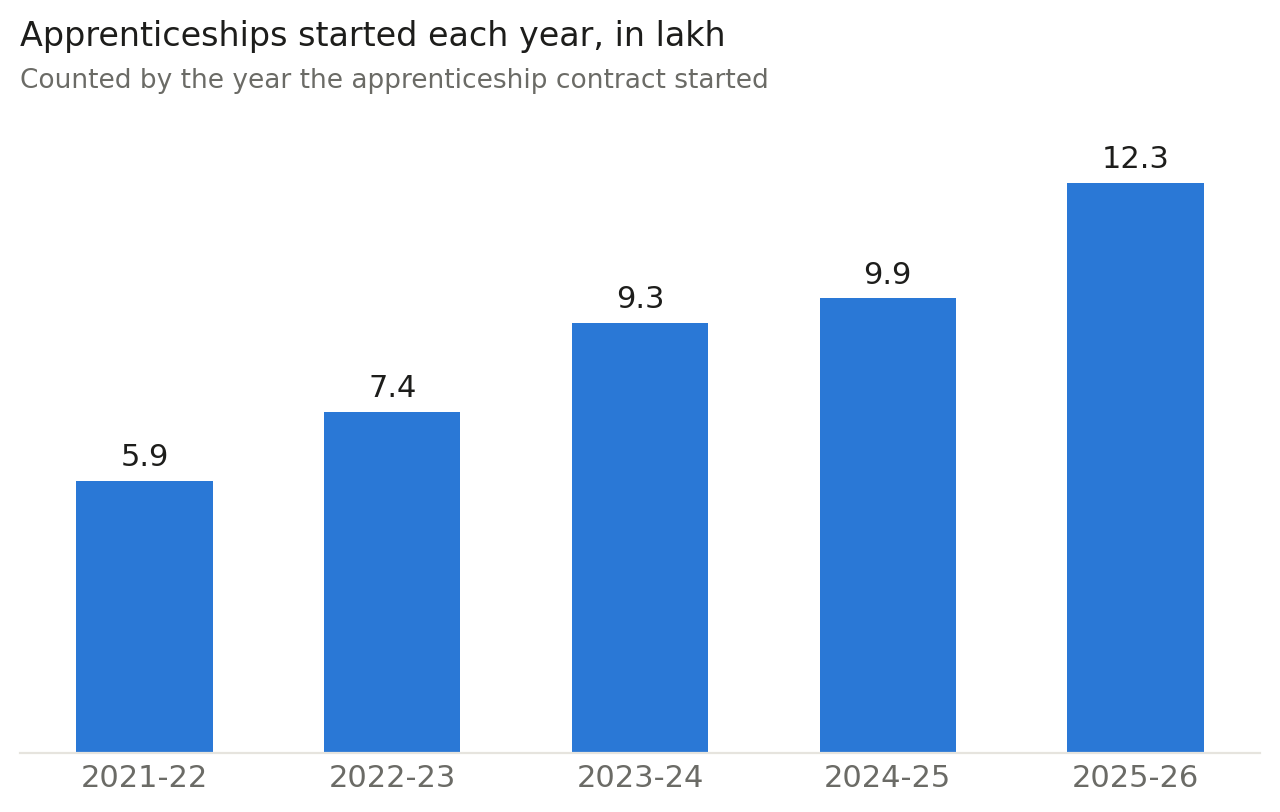
In 2025-26, 12.3 lakh apprenticeships began in India, twice the 5.9 lakh of 2021-22; about 58 lakh have begun since 2018-19. The government counts them under the National Apprenticeship Promotion Scheme (NAPS), through which it shares the cost of stipends with employers.¹ Apprentices are trainees, not employees, in government-designated trades or in trades chosen by employers, where training lasts from six months to three years. NAPS was extended to 30 September 2026; apart from a programme for the North-East, no order extending it beyond that date has been published.²
 Source: Ministry of Skill Development and Entrepreneurship, 2026.
40% of apprentices train in just ten districts
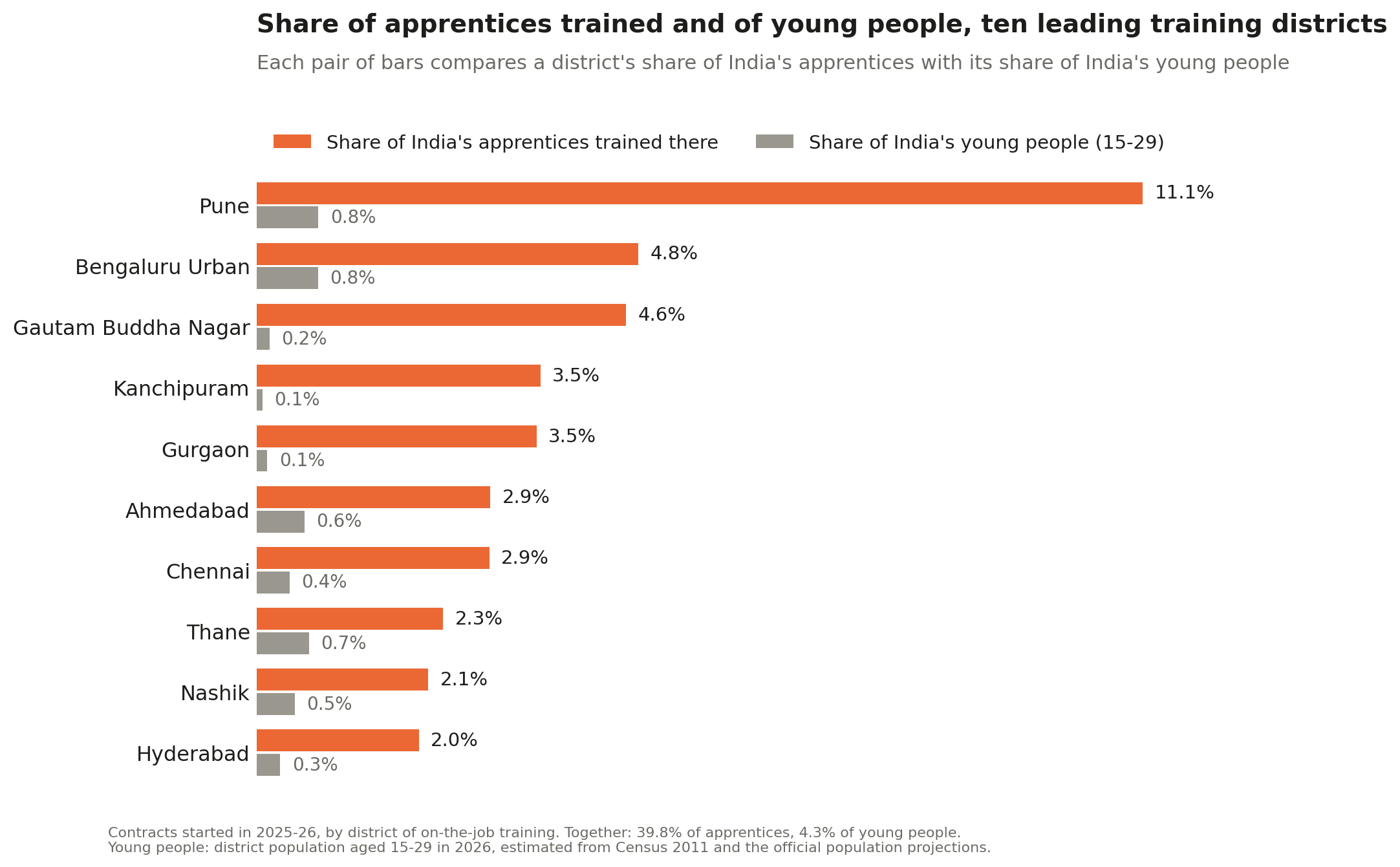
Ten districts, Pune, Bengaluru Urban, Gautam Buddha Nagar, Kanchipuram, Gurgaon, Ahmedabad, Chennai, Thane, Nashik and Hyderabad, train 40% of India’s apprentices but have 4% of its young people. The 629 districts with the fewest training places are home to two-thirds of young people and train 11% of apprentices, down from 18% in 2021-22.³
 Source: Ministry of Skill Development and Entrepreneurship, 2026.
Nearly three in four apprentices have to travel outside their district to train
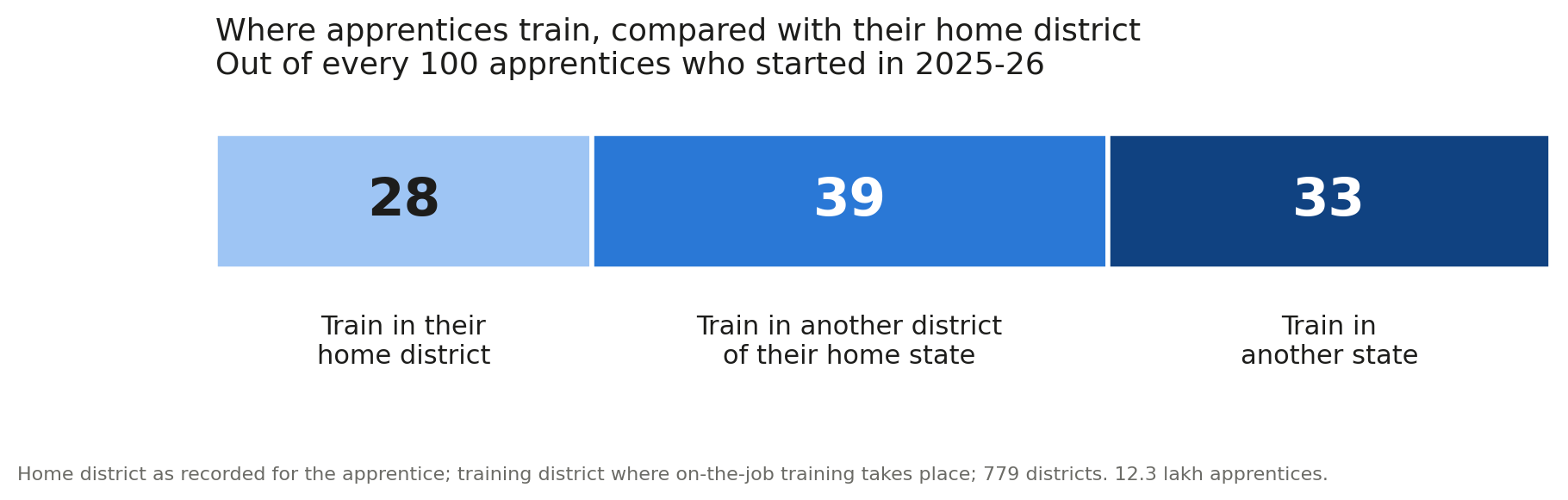
Of the apprentices who started in 2025-26, 72% trained outside their home district and 33% outside their home state. Among apprentices from Bihar, 88% trained in another state. Even in the ten leading districts, only about one in six apprentices is local.⁴
 Source: Ministry of Skill Development and Entrepreneurship, 2026.
But nearly two in five leave before finishing
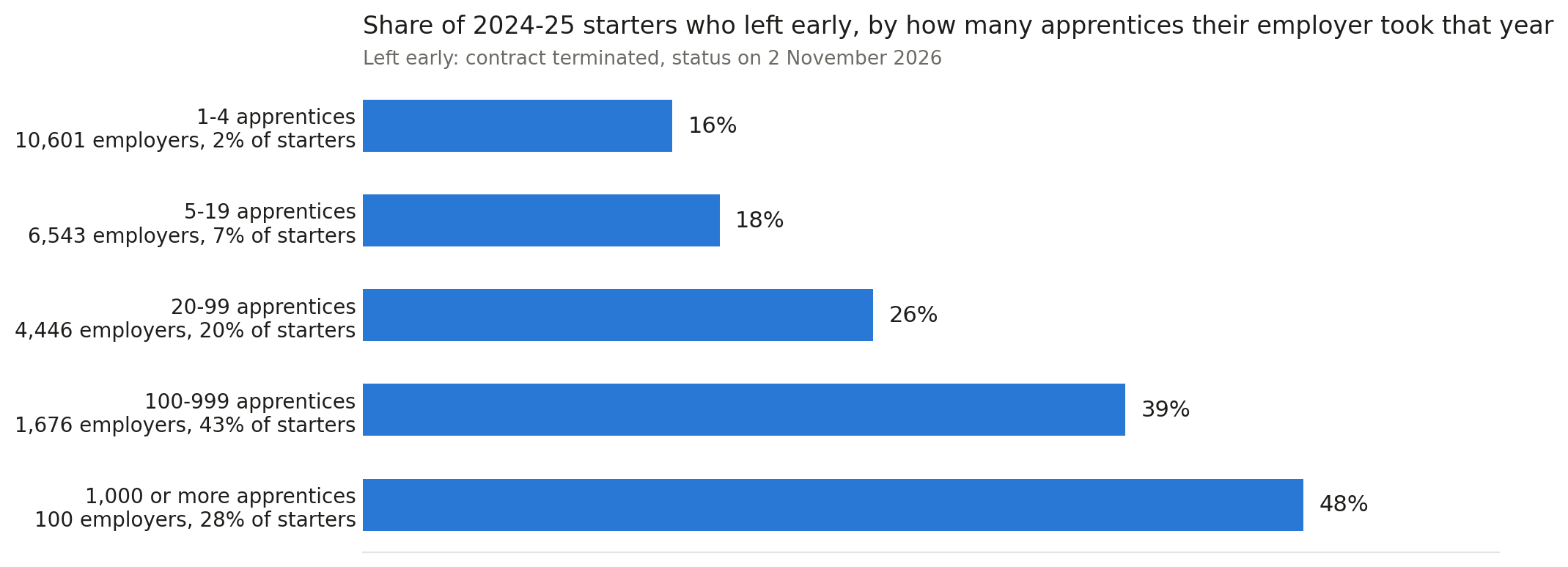
Of the 9.9 lakh apprentices who started in 2024-25, 61% completed their training and 37% left early, up from 34% of those who started in 2021-22.⁵ It is not clear whether leaving is related to distance or to the employer. The two are mixed: the largest employers, which lose the most apprentices, are concentrated in a few districts, so the young people they take on usually have to travel.⁶
 Source: Ministry of Skill Development and Entrepreneurship, 2026.
Few employers, thin support
Employers with 30 or more workers must take on apprentices equal to 2.5% to 15% of their workforce,² yet six in ten employers registered on the scheme’s portal whose size is recorded have never taken one.⁷ Under NAPS the government’s share of the stipend was capped at ₹1,500 a month; payment records for June to September 2026 show it averaged about ₹1,400 a month, a tenth of the stipend recorded, with employers’ share about ₹13,100.⁸ A third-party evaluation by the Arun Jaitley National Institute of Financial Management, as reported by the government, found that 72% of apprentices surveyed reported receiving offers of full-time employment after completing their training. Offers after completion can only go to those who complete, and about three in five do, so this corresponds to fewer than half of those who start. The evaluation report has not been published, so details such as its sample and methods, how many apprentices accepted the offers, and the terms offered are not available.⁹
What would make NAPS work
First, bring in more employers where young people live. Most apprentices who started in 2025-26 trained outside their home district,⁴ and employers that took fewer than 20 apprentices in 2024-25 lost fewer than one in five of them;⁶ small firms in a district could join the scheme together through local clusters.¹⁰ Second, publish completion rates for every employer, and review the 100 largest, which lost nearly half of those who started in 2024-25.⁶ Third, publish the evaluation and record what happens after training, so the scheme is judged by whether apprentices finish and find work, not only by how many start.
Notes
¹ Apprenticeship Performance Dashboard, Ministry of Skill Development and Entrepreneurship, accessed 2 November 2026. Apprenticeships are counted as contracts, by the year the contract started: 12,34,366 in 2025-26 and 5,90,217 in 2021-22; 57,82,842 since 2018-19, of which 30,31,216 have been completed. Counts cover all contracts on the dashboard. They equal the ministry's reported numbers of apprentices engaged under NAPS for 2020-21 to 2024-25 (for example 9.85 lakh in 2024-25). The dashboard marks only some contracts as NAPS (77.6% of 2025-26 starts) and does not define the mark. A person can hold more than one contract.
² Apprentices Act, 1961, Section 22 (no obligation to offer a job after training unless the contract says so). Training periods: Apprenticeship Rules, 1992, Rule 7A(3) as amended in September 2019 (six months to three years for trades chosen by employers); designated trades follow Schedule I. Scheme period: the apprenticeship portal’s notice extending NAPS-2 to 30 September 2026; apart from a special programme for the North-Eastern Region extended for 2026-27 (Ministry of Skill Development and Entrepreneurship, 17 July 2026), no later extension order, or approval of a successor scheme, was found as of 17 November 2026. Employer thresholds: Revitalizing India’s Apprenticeship Ecosystem, NITI Aayog, February 2026, pp. 10-11 and 18.
³ Same dashboard, contracts started in 2025-26, by district of on-the-job training, matched to 779 districts. Young people: district population aged 15-29 in 2026, estimated from Census 2011 and the official population projections. The ten districts train 39.8% of apprentices and hold 4.3% of young people. The 629 districts are those with the fewest apprentices training in them in 2025-26; they hold 67.5% of young people and train 10.5% of apprentices, down from 18.3% in 2021-22 for the same districts.
⁴ Same dashboard, contracts started in 2025-26, comparing the apprentice’s recorded home district with the district of on-the-job training: 28.2% train in their home district, 38.6% in another district of their home state and 33.2% in another state (12,34,358 apprentices). Bihar: 88.4% of apprentices whose home state is Bihar train in another state. Ten leading districts: of contracts started there in 2024-25 that had been completed or terminated by 2 November 2026, 16% were apprentices from the same district.
⁵ Same dashboard, contracts started in 2024-25, by status on 2 November 2026: 61.1% completed, 37.1% terminated, 1.8% still running, pending or transferred to another employer. Terminated share of 2021-22 starts: 33.7%.
⁶ Same dashboard. Left early, contracts started in 2024-25, by the number of apprentices the employer started that year: 1,000 or more (100 employers, 28% of all starts) 48.0%; 100-999, 38.9%; 20-99, 26.0%; 5-19, 18.2%; 1-4, 15.8%. Distance, contracts started in 2023-24 and 2024-25: across all employers, 42.8% of apprentices from another state left early against 27.7% of those training in their home district; comparing apprentices at the same employer and training district, the difference is about 2.5 percentage points. Of contracts started in 2024-25 and completed or terminated, employers with 1,000 or more apprentices trained 55.1% in the ten leading districts (employers with fewer than 20: 19.7%) and 79.3% outside the apprentice’s home district (fewer than 20: 43.5%).
⁷ Same dashboard, registered establishments: 1,48,337 have a size category recorded, of which 58,468 (39%) have ever taken an apprentice. Across all 2,28,823 registrations the share is 27.5%; about a third of registrations have no size category recorded.
⁸ Stipend payment records on the same dashboard, June to September 2026: per apprentice-month on the records, the employer’s share averaged ₹13,095 and the government’s ₹1,422 (9.8% of the total). Government support: 25% of the stipend up to ₹1,500 a month (NITI Aayog, 2026, pp. 11-12).
⁹ Ministry of Skill Development and Entrepreneurship, replies in Parliament, March to July 2026, on a third-party evaluation of the scheme covering 2022-23 to 2025-26, submitted in December 2025 and not published. The ministry describes the figure as the share of apprentices surveyed who reported receiving offers of full-time employment after completing training. Of contracts started from 2022-23 to 2024-25, 63.2% were completed by 2 November 2026 (same dashboard as note 1); 72% of 63.2% is 45.5% (44.0% for contracts started in 2024-25).
¹⁰ NITI Aayog (2026) recommends cluster-based participation by small firms and a larger role for District Skill Committees.