India cannot achieve mass prosperity without making farming pay better
In 50% of India's districts, almost 50% of workers still farm, and good jobs outside farming are few.
In 50% of India's districts, almost 50% of all workers still farm. Outside farming, good jobs are few, and most of them are government jobs that cannot multiply. Farming will stay the main work for a very large number of people for years to come. Making it pay better is as urgent as creating jobs beyond it.
In 50% of India's districts, almost 50% of all workers farm
Across 779 districts, the middle district has 48% of its workers in farming, forestry or fishing.¹ In 450 districts, the share is 45% or more. In 165, it is 60% or more. These districts are spread across the country, including in states seen as richer. Together they are home to 51% of India's people, about 72 crore.²
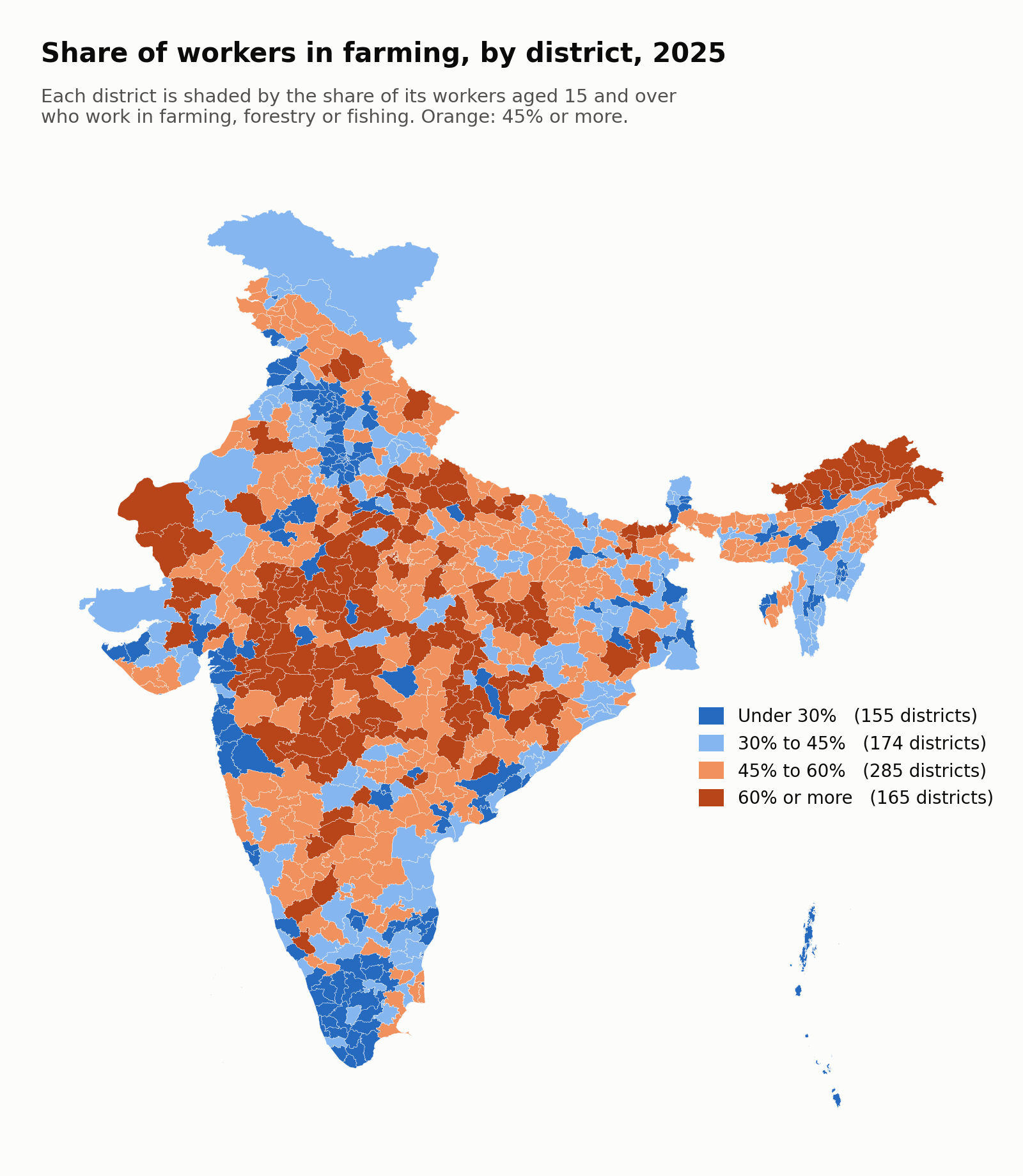 Source: MoSPI 2025.
In these districts, there is little good work outside farming
The general advice is that we must move people off the farms in what is known as structural transformation. However, in these 450 districts, there is little good work to move into.
Only 4% of workers have a salaried job paying ₹20,000 a month, and most are government jobs
Only 4% of workers in these districts have a salaried job that pays ₹20,000 a month or more.³ Government employs 57% of them, mostly teachers, clerks, and police and other security staff.⁴ A typical government salary here is ₹25,000 a month. A typical private salary is ₹12,000.
Government jobs cannot absorb the people leaving farming. Their number is set by budgets, not by how many people need work.
Most other work is daily labour or self-employment
19% of workers outside farming are construction or mining labourers, hired by the day for about ₹400, or about ₹9,300 a month at the days they find work. The next largest group is shop salespersons, most of them running their own shops.
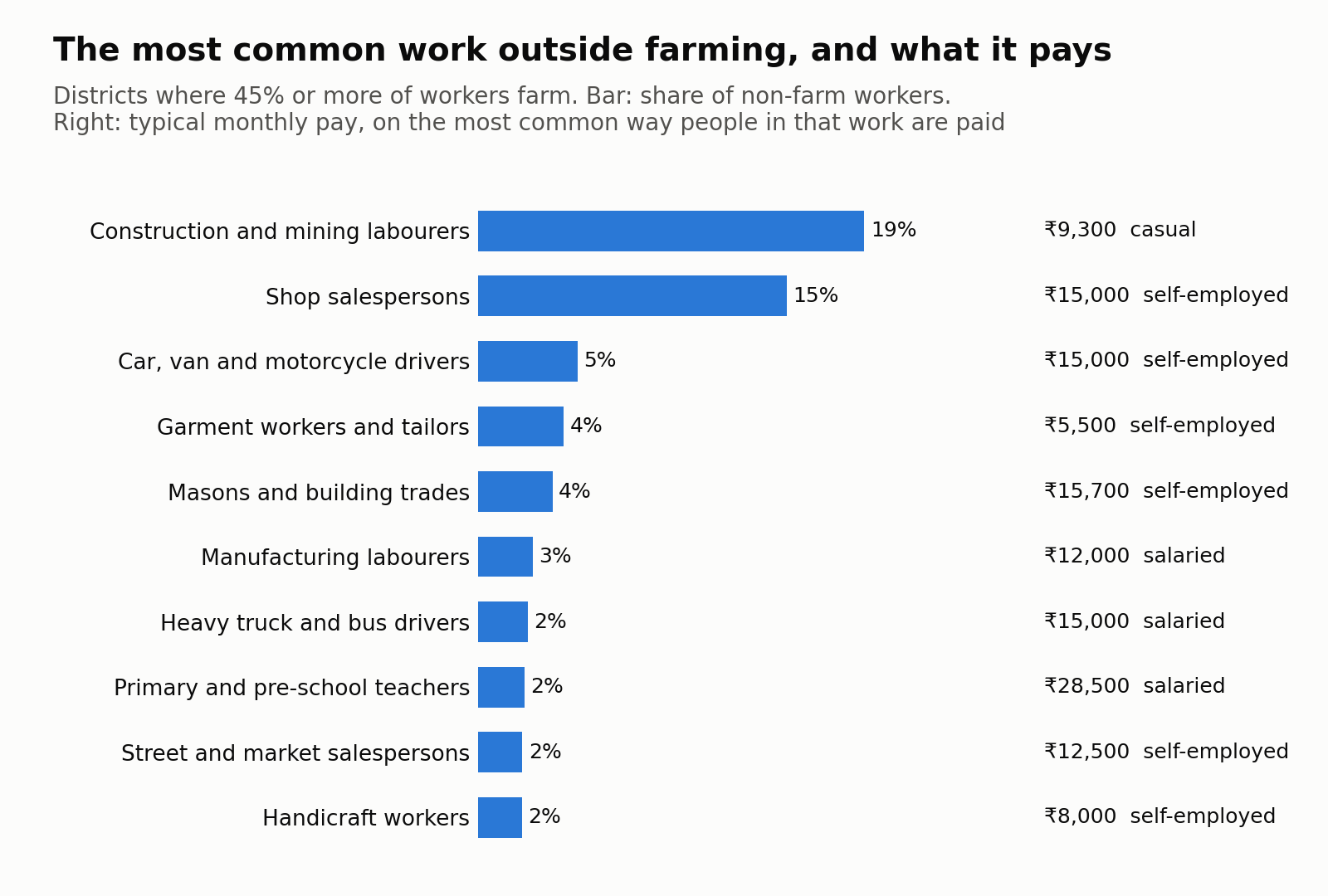 Source: MoSPI 2025.
We have to make farming pay better
Large numbers will depend on farming for years
With few good jobs outside farming, and most of those set by government budgets, people in these districts will leave farming slowly. For years, farming will remain the main work for more than 50% of their workers.
And it is not just these 450 districts. Across India, 43% of all workers, about 22 crore people, still depend on farming.⁵
Farming pays very little
A self-employed farmer here typically earns ₹9,000 a month. That income often also pays for family members who help on the farm without a wage of their own. In these districts there are about 6 such helpers for every 10 self-employed farmers. A farm labourer earns about ₹6,100 a month at the days worked. Work outside farming pays more, but for most people who leave, it means daily labour or working for themselves.
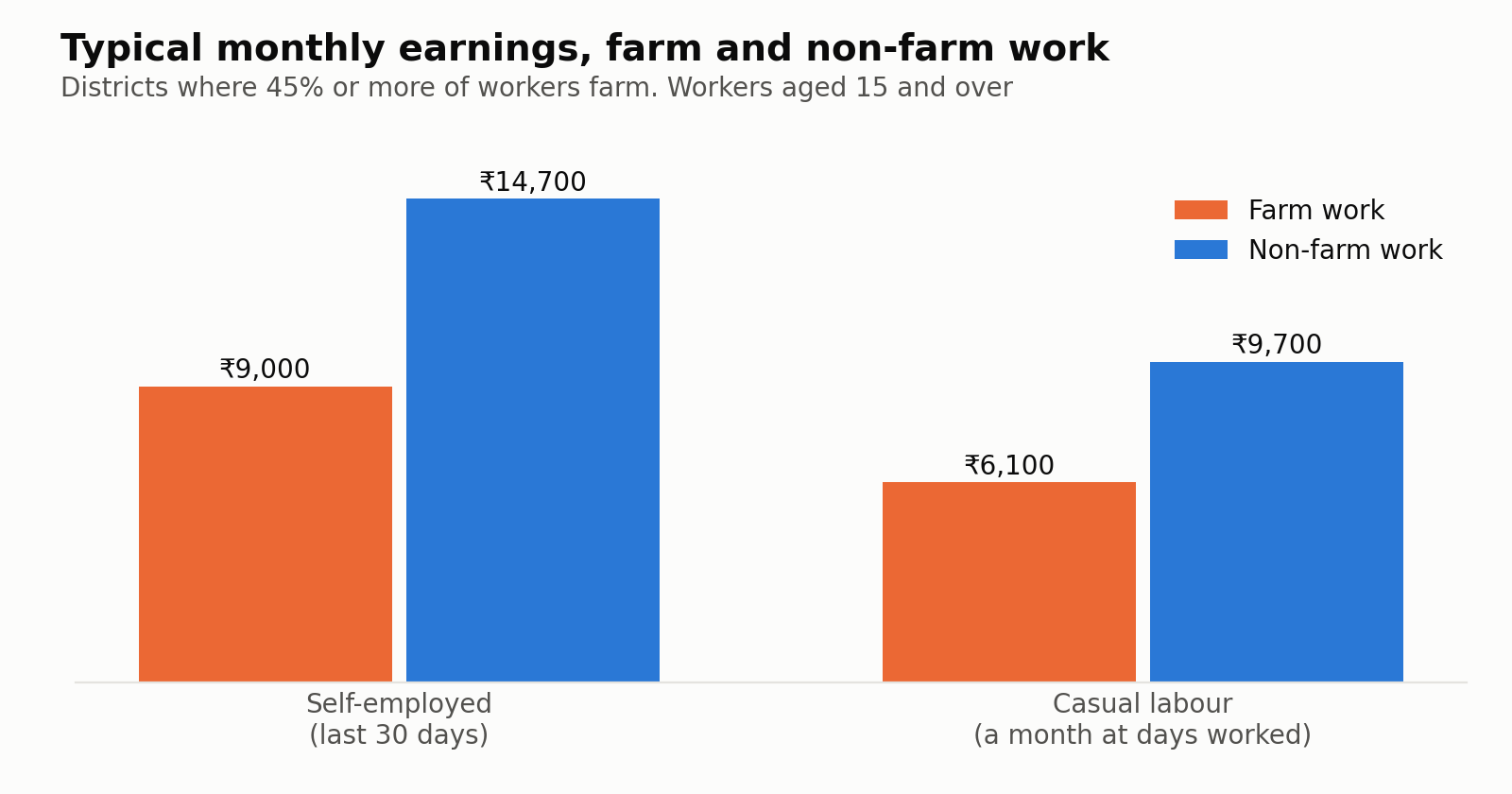 Source: MoSPI 2025.
We are not creating enough jobs at high enough wages to move people out of farming. Moving them off the land anyway creates a surplus of workers, which depresses wages across the economy. As long as so many depend on farming, raising what farming pays matters as much as creating jobs outside it.
Notes
¹ Share of workers aged 15 and over in farming, forestry or fishing, by the industry of their main work over the year (or of their subsidiary work, for people who were otherwise not working or looking for work for most of the year), 2025. The middle district is at 47.7%. 265 districts have no survey sample of their own; their value is taken from their survey region or parent district.
² Population of the 450 districts, projected for 2026.
³ Job and pay figures cover workers aged 15 and over in the 266 districts at 45% or more that have their own survey sample. The 4% is the share of workers, counted by their main work over the year, who held a salaried job outside farming, were working in it in the survey week, and were paid ₹20,000 or more for the previous month. Pay is the previous month's salary for salaried workers and earnings in the last 30 days for the self-employed; unpaid family helpers have no earnings of their own and are not included. For casual labourers, the typical daily wage is multiplied by the average number of days worked in a week, over a month. Each occupation's pay in the chart is for the most common way people in it are paid.
⁴ Government here includes local bodies, public sector enterprises and autonomous bodies.
⁵ Workers aged 15 and over in farming, forestry or fishing, by the industry of their main work over the year (or of their subsidiary work, for people who were otherwise not working or looking for work for most of the year), all India, 2025.
Follow our blog to stay updated on our programs and other content ↗