Only 41% of government employees have a “government job”
Of the 2.7 crore government employees, only 1.1 crore have a secure job that pays at least the minimum wage and full benefits
Topics: Government jobs · Jobs · Youth
The government job we imagine
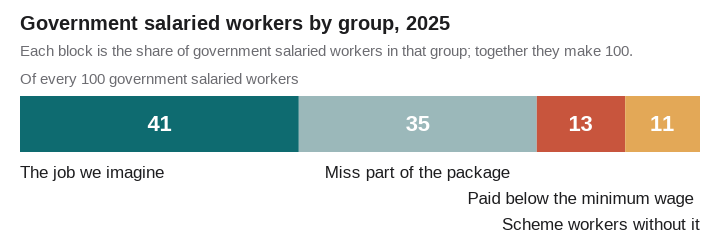
When we think of a government job, we think of full-time work that pays well, is secure, and comes with a pension, health cover and paid leave. Yet only 41% of government employees, about 1.1 crore people, have a secure job with full benefits that pays at least the minimum wage.
 Source: Ministry of Statistics and Programme Implementation, labour survey 2025; our calculations.
Counts of government jobs vary widely
India has no up-to-date count of government employees. The last official count, for March 2012, put them at 1.18 crore; later estimates put them at 1.5 crore to 2 crore.¹ Yet about 2.7 crore people say their main paid work is a salaried job with a government or local body. Much of the difference is likely people who work for the government without being employed by it on regular terms: scheme workers, cooks, cleaners and contract staff.
Between 31% and 56% of government employees lack the security and benefits of a government job
Even on the loosest test, any written contract and any social security, 31% of government salaried workers lack a contract, social security or both. On a test closer to the job we imagine, a contract of more than three years with a pension or provident fund, gratuity and health or maternity cover, 56% fall short. Those who have the job we imagine earn a median of ₹46,300 a month; everyone else earns ₹15,000.
34 lakh government employees are paid less than the minimum wage
About 34 lakh people, 13% of government salaried workers, are paid less than their state's minimum wage for unskilled work.² They include 3.6 lakh primary and pre-primary teachers. Their median pay is ₹9,000 a month, and 47% are women. The largest groups are cleaners, sanitation and refuse workers, teachers, guards and other protective staff, and clerks. Any government job that pays less than the minimum wage is a gap the government can close itself.
31 lakh scheme workers, 95% of them women, earn a median ₹6,200
About 31 lakh government salaried workers, 11%, work in occupations such as community health workers (ASHAs), anganwadi workers and helpers, teachers' aides and cooks, many of them in government schemes, where work is often part-time and paid an honorarium rather than a wage. Of them, 68% work less than eight hours on the days they work, typically six. About 8 lakh of them work full days and are still paid below the minimum wage.
Of these workers, 57% say their work gives them no social security benefits. The government has extended Ayushman Bharat health cover to ASHA and anganwadi workers, and the labour codes in force since November 2025 aim at social security for all workers. In line with that aim, these workers should also have a pension, accident cover and maternity support.
Another 35% of government employees miss part of the package
The remaining 35% of government salaried workers, about 95 lakh people, are paid at least the minimum wage but lack part of what we expect of a government job. Of them, 79% lack at least one of a pension or provident fund, gratuity and health or maternity cover, and 52% lack a contract of more than three years. The largest groups are guards and other protective staff, teachers and clerks. Their median pay is ₹28,000 a month.
So only about 1.1 crore people have the government job we imagine
About 1.12 crore people, 41% of government salaried workers, have the job we think of as a government job: secure, with full benefits, and paying at least the minimum wage. That is under 2% of all Indian workers. Women are 35% of government salaried workers but only 24% of those with the job we imagine. Government work is also a shrinking share of jobs for the young, down from 4.1% of young workers in 2017-18 to 2.9% in 2025.³ Only about 10 lakh young people have the government job we imagine: 28% of young government salaried workers, and under 1% of all young workers.
Notes
¹ The 2012 figure covers the central and state governments and local bodies; including government-owned companies it was 1.76 crore. The estimates are roughly 1.5 crore on central and state government payrolls, excluding the armed forces (Economic Survey 2017-18), and about 2 crore in 2017, including government bodies and companies (economists at IIM Bangalore and the State Bank of India).
² We compare each worker's monthly pay with their state's minimum wage for unskilled work in its lowest-paid area, at the rates in force in July 2025. This is a benchmark comparison, not a legal finding about any worker. Scheme workers are not counted in this gap.
³ Counts everyone whose main work is with a government department or local body, salaried or not. Government workers of all ages rose from about 3 crore to 3.4 crore, more slowly than the workforce, and young workers grew from about 11.3 crore to 15 crore. The 2025 survey was redesigned, so comparisons with 2017-18 are approximate.
Government employees are regular salaried employees aged 15 and over of a government department or local body, as they report it, who were at work in the survey week and reported earnings. Government-owned companies are not included, nor are officials paid below the minimum wage, most likely elected local-body members. The job we imagine means a pension or provident fund, gratuity and health or maternity cover, a written contract of more than three years, paid leave, and pay at or above the minimum wage. Scheme workers (community health and anganwadi workers, teachers' aides and cooks) are identified by occupation and the service they work in; nursing associates outside education, public administration and social work who are paid below the minimum wage are also counted as community health workers. The survey does not record scheme membership or how pay is described. Hours are hours of all work on the days worked. Workers whose social security is not known are not counted as lacking it, but do not count as having the full package. Numbers are survey shares applied to India's projected population.
Source: Ministry of Statistics and Programme Implementation, labour surveys 2017-18 and 2025; Ministry of Labour and Employment, 2012 employment figures (as reproduced in the Economic Survey 2017-18); Economic Survey 2017-18; P. Ghosh and S. K. Ghosh, January 2018; state minimum wage notifications, July 2025; population projections. Our calculations.